

Penile implant vs injections is the choice many men face when ED tablets stop working: injections are a reversible drug treatment that produces an erection in more than 70% of men within minutes, while an implant is a one-time operation with one of the highest satisfaction rates of any ED treatment. The catch is that most injection users eventually stop, whereas implants work for years but permanently replace natural erections. This guide compares them point by point.
Source: EAU Guidelines — Sexual and Reproductive Health: Management of erectile dysfunction
- Penile injections (alprostadil or Trimix) work in more than 70% of men within 5–15 minutes, but 41–68% of men stop using them, mostly in the first 2–3 months.
- A penile implant gives one of the highest satisfaction rates of any ED treatment (at least 92% of men, 91–95% of partners) but needs surgery and permanently replaces natural erections.
- In a head-to-head penile implant vs injections comparison, implant users scored much higher on treatment satisfaction than injection users (82 vs 58 on the EDITS index).
- In penile implant vs injections terms, injections are reversible and cheaper to start; an implant is a one-time decision with a 2–3% infection risk and devices that may need replacing after many years.
- EAU guidelines place injections as an alternative first-line or second-line option and implants for men who do not respond or want a definitive solution.
- Two options for ED when pills fail
- Penile implant vs injections: how often each works
- Why so many men stop injections
- Penile implant vs injections side by side
- Penile implant vs injections: risks compared
- Reversibility, length and sensation
- Cost, recovery and everyday use
- Penile implant vs injections: how to decide
- When to see a doctor
- FAQs about penile implant vs injections
Two options for ED when pills fail

Penile implant vs injections: both treatments act on the same place, the corpora cavernosa (the two erection chambers in the shaft), but in very different ways. With intracavernosal injection, a man uses a fine needle to inject a drug that relaxes the erectile tissue; blood rushes in and the penis hardens within 5–15 minutes. With an implant, a surgeon places two cylinders inside the erection chambers; in the inflatable type, a pump in the scrotum fills them with fluid from a reservoir behind the abdominal muscles whenever the man wants an erection.
Source: EAU Guidelines — Sexual and Reproductive Health: Management of erectile dysfunction; Cleveland Clinic — Penile implants
The drugs used for injections are alprostadil (Caverject, Edex/Viridal), which is the only one licensed for this use, and unlicensed mixtures such as Bimix and Trimix (papaverine, phentolamine and alprostadil). Our complete guide to penile injections explains doses and training in detail; the full implant procedure is described on our penile prosthesis surgery page. Here we focus only on how the two compare.
Source: EAU Guidelines — Sexual and Reproductive Health: Management of erectile dysfunction
Penile implant vs injections: how often each works
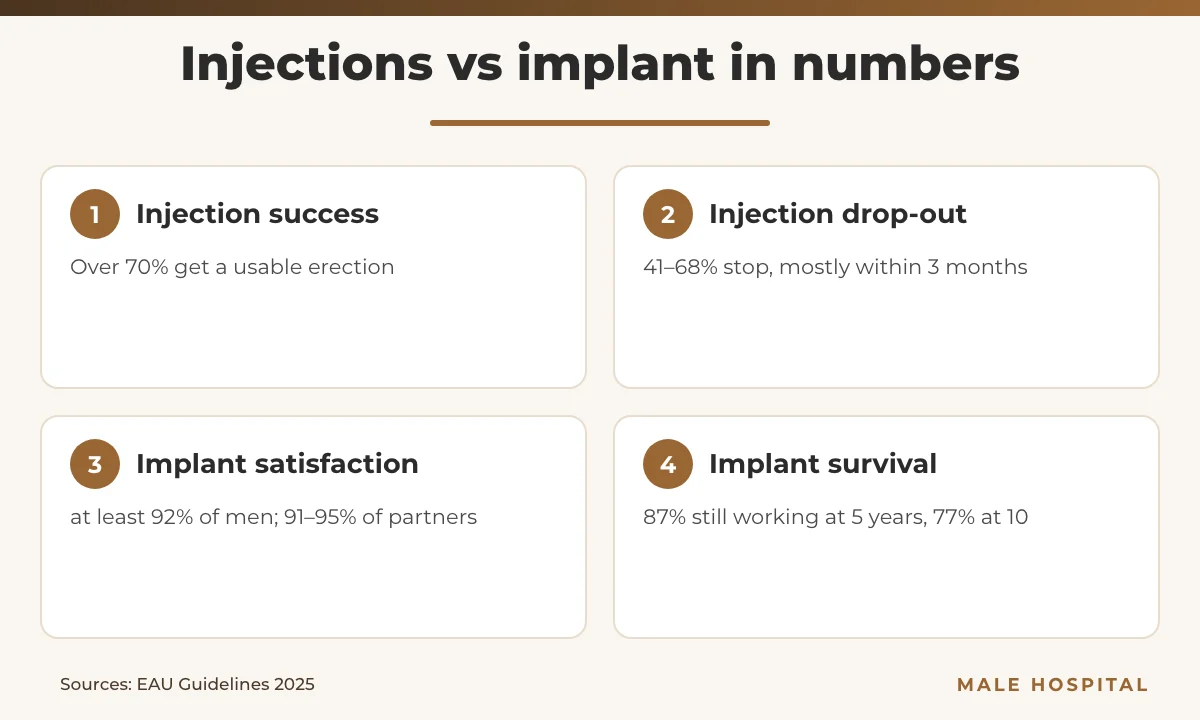
Intracavernosal alprostadil works in more than 70% of men with ED, including men with diabetes or heart disease, and Trimix reaches efficacy rates of about 92%. Between 5% and 10% of men do not respond to any injection, usually because of severe blood-vessel damage or a venous leak.
Source: EAU Guidelines — Sexual and Reproductive Health: Management of erectile dysfunction
An implant does not rely on blood flow at all: the cylinders create the rigidity mechanically, so it works even when the erectile tissue no longer responds to any drug. EAU guidelines describe implant satisfaction as among the highest of all ED treatments, at at least 92% of patients and 91–95% of partners with appropriate counselling.
Source: EAU Guidelines — Sexual and Reproductive Health: Management of erectile dysfunction
Head-to-head studies
Direct penile implant vs injections comparisons are few and old, but consistent. In a Detroit study of 85 men followed for an average of 19.5 months, implant users scored 82.0 on the EDITS satisfaction index, compared with 58.2 for men on alprostadil injections and 61.5 for men on sildenafil. Erectile function scores were also higher with implants (27.9 vs 22.9 out of 30 for injections).
In a North Carolina study with an average follow-up of 5.4 years, only 41% of injection users were still injecting, while 70% of implant patients were still sexually active with their device. Implants were used for an average of 63 months versus 37 months for injections.
Why so many men stop injections
High drop-out is the biggest weakness of injections. EAU guidelines report that 41–68% of men discontinue them, most within the first two to three months. In a study of men who had started injections more than five years earlier, only 32% were still using them, and 56% of those who stopped did so in the first year.
Source: EAU Guidelines — Sexual and Reproductive Health: Management of erectile dysfunction; Sundaram CP et al., Urology 1997 (PubMed) — Long-term follow-up of patients receiving injection therapy for erectile dysfunction
The reasons men gave in that study were a wish for a permanent solution (29%), no suitable partner (26%), fear of needles (23%), a poor response (23%), fear of complications (22%) and lack of spontaneity. In the North Carolina series the leading reasons were inadequate erections, lack of spontaneity and side effects.
Source: Sundaram CP et al., Urology 1997 (PubMed) — Long-term follow-up of patients receiving injection therapy for erectile dysfunction; Sexton WJ et al., J Urol 1998 (PubMed) — Comparison of long-term outcomes of penile prostheses and intracavernosal injection therapy
Not every man who stops is unhappy: in the same five-year study, 82% would still recommend injections to a friend, and there is a core group who use them successfully for many years. Close follow-up during the first months, when most men drop out, makes a real difference.
Source: Sundaram CP et al., Urology 1997 (PubMed) — Long-term follow-up of patients receiving injection therapy for erectile dysfunction; EAU Guidelines — Sexual and Reproductive Health: Management of erectile dysfunction
Penile implant vs injections side by side
| Feature | Injections | Penile implant | |
|---|---|---|---|
| How it works | Drug injected into the shaft before sex | Cylinders inside the penis, inflated with a scrotal pump (or bendable rods) | |
| Time to erection | 5–15 minutes | A couple of minutes of pumping once healed | |
| Success | Over 70% (Trimix up to 92%) | Works mechanically, regardless of blood flow | |
| Satisfaction | 87–93.5% of users, 86–90.3% of partners | at least 92% of men, 91–95% of partners | |
| Long-term use | 41–68% drop out | Device survival 87.2% at 5 years, 76.8% at 10 | |
| Limits on use | No more than 3 times a week, 24 hours apart | No limit; erection lasts as long as desired | |
| Reversible? | Yes, stop at any time | No; natural erections and pills no longer work after removal | |
| Main risks | Pain, prolonged erection (5%), priapism (1%), fibrosis (2%) | Infection (2–3%), mechanical failure, erosion |
Source: EAU Guidelines — Sexual and Reproductive Health: Management of erectile dysfunction; MedlinePlus — Alprostadil Urogenital; Cleveland Clinic — Penile implants
Penile implant vs injections: risks compared
Injection risks
With alprostadil, about half of men report pain at some point, although only after about 11% of injections, and pain often eases with time. Prolonged unwanted erections occur in 5%, true priapism in 1% and fibrosis (scarring) in 2%; fibrosis is more common (5–10%) with papaverine mixtures. Scarring in the outer sheath can be an early sign of Peyronie’s disease and may mean stopping injections for good. Men with bleeding disorders or a high risk of priapism should not use them.
Source: EAU Guidelines — Sexual and Reproductive Health: Management of erectile dysfunction
Implant risks
The two main implant complications are infection and mechanical failure. Infection rates are 2–3% for first implants in low-risk men at high-volume centres, falling to 1–2% with antibiotic-coated or hydrophilic-coated devices. An infected implant normally has to be removed. Erosion of the device through tissue occurs in 1–6%, and glans ischaemia (loss of blood supply to the head of the penis) in about 1.5%, mainly in men with severe vascular disease. Our article on penile implant complications covers each risk.
Source: EAU Guidelines — Sexual and Reproductive Health: Management of erectile dysfunction
Devices also wear out. A meta-analysis cited by the EAU found implant survival of 93.3% at 1 year, 87.2% at 5 years, 76.8% at 10 years and 52.9% at 20 years. Revision surgery carries a higher infection risk than a first implant.
Source: EAU Guidelines — Sexual and Reproductive Health: Management of erectile dysfunction; O’Rourke TK et al., Transl Androl Urol 2017 (PMC) — Prevention, identification, and management of post-operative penile implant complications of infection, hematoma, and device malfunction
Reversibility, length and sensation
In the penile implant vs injections decision, this is the point that matters most to many men. Injections leave the body unchanged: a man can stop, switch to another treatment or try an implant later. An implant permanently changes the erectile tissue. Cleveland Clinic notes that after implant surgery, medicines no longer work and natural erections are not possible, especially if the device is removed and not replaced.
Source: Cleveland Clinic — Penile implants
Implants also do not make the penis bigger. The glans does not swell, which can make the erection feel shorter than men remember. ISSM explains that much of the length loss men notice comes from years of ED, Peyronie’s disease, prostate cancer treatment or low testosterone before surgery, not only from the implant. Sensation, ejaculation and orgasm are not changed by the implant.
Source: Cleveland Clinic — Penile implants; ISSM — Is it common to lose length after penile implant surgery?
For injections, the main long-term structural risk is scarring, which is why men who inject often are checked for lumps or curvature at follow-up.
Source: EAU Guidelines — Sexual and Reproductive Health: Management of erectile dysfunction
Cost, recovery and everyday use
On penile implant vs injections costs, injections have a low starting cost but are paid for with every use, and they need training in the clinic before self-injection. An implant has a high one-time cost: Cleveland Clinic gives a typical US price of $12,000 to $20,000, which varies by surgeon and facility. Our article on penile implant cost breaks down the factors in more detail.
Source: Cleveland Clinic — Penile implants
Recovery after an implant is real but limited. Pain and swelling usually ease after a week, tenderness can last up to six weeks, and sex is generally avoided for at least four weeks. Desk workers usually take about a week off. Men are typically taught to use the device at a visit four to six weeks after surgery. After that, an erection is available on demand and can last as long as the man wishes, even after orgasm.
Source: Cleveland Clinic — Penile implants
Penile implant vs injections: how to decide
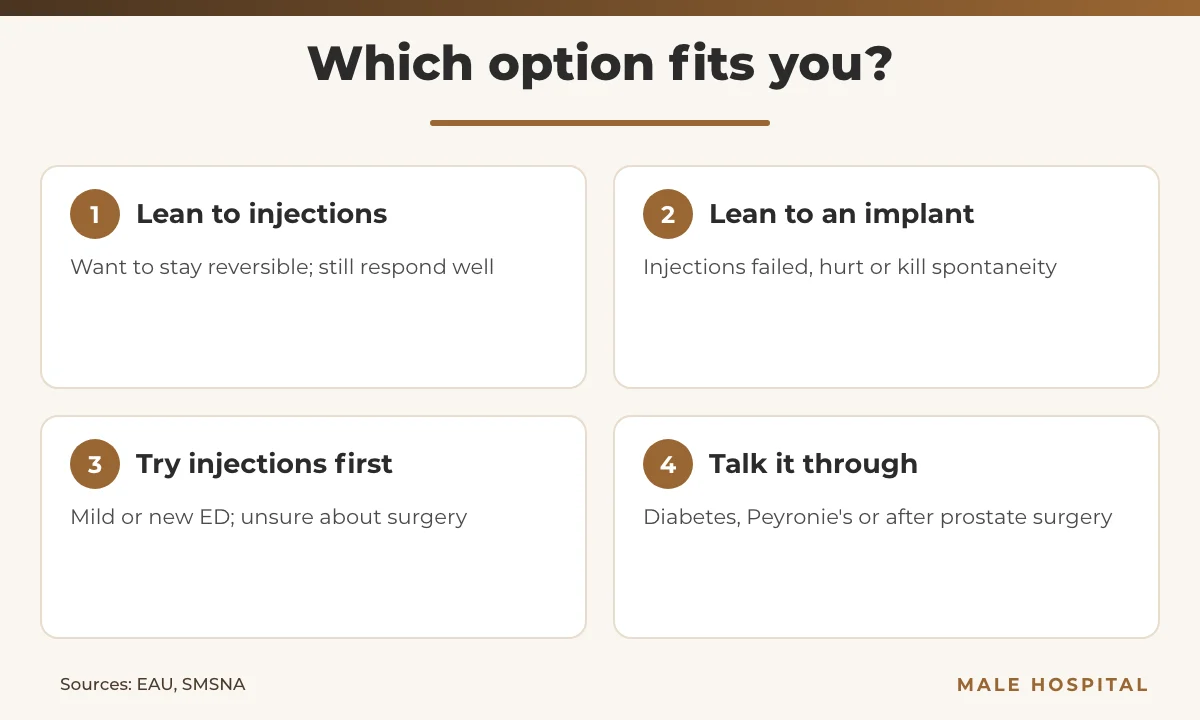
For penile implant vs injections, EAU guidelines recommend injections as an alternative first-line therapy in well-informed men or as a second-line therapy after tablets, and an implant for men who are not suitable for drug treatments, prefer a definitive therapy, or do not respond to other options. The Sexual Medicine Society of North America (SMSNA) adds that recent AUA guidance supports men who have failed pills choosing an implant directly if they understand the benefits, risks and burdens.
Source: EAU Guidelines — Sexual and Reproductive Health: Management of erectile dysfunction; SMSNA — Penile implants for erectile dysfunction: a Q&A with an implant specialist
Questions that usually decide the matter:
- Do injections give you a firm erection at a dose you tolerate? If yes, there is little urgency to operate.
- Do you dread the needle or feel it kills spontaneity? These are among the commonest reasons for quitting.
- Have you developed pain, lumps or curvature from injections?
- Do you want to keep every future option open, or would you rather have one reliable solution?
- Do you have health problems, such as poorly controlled diabetes, that raise surgical risk?
Source: Sundaram CP et al., Urology 1997 (PubMed) — Long-term follow-up of patients receiving injection therapy for erectile dysfunction; EAU Guidelines — Sexual and Reproductive Health: Management of erectile dysfunction
Men with milder ED may also consider the gentler alprostadil cream, although it is less effective than injections.
When to see a doctor
Whichever route you choose, a urologist should guide it. Seek urgent care if:
- an erection after an injection lasts more than 4 hours (priapism);
- you develop fever, increasing pain, redness or discharge after implant surgery;
- you notice a new bend, hard lump or painful area in the penis after injections;
- a needle breaks or you faint or feel your heart racing after an injection.
Source: MedlinePlus — Alprostadil Urogenital; Cleveland Clinic — Penile implants
If you would like an honest assessment of which option suits you, you can reach our urologist-andrologist confidentially on WhatsApp; there is no obligation to choose surgery.
FAQs about penile implant vs injections
Penile implant vs injections: which is better?
In penile implant vs injections, neither is better for everyone. Injections work in more than 70% of men and keep all future options open, but 41–68% of men eventually stop them. Implants produce higher satisfaction scores in comparison studies and work regardless of blood flow, but they require surgery and are irreversible. The right choice depends on your response, comfort and goals.
Source: EAU Guidelines — Sexual and Reproductive Health: Management of erectile dysfunction; Rajpurkar A, Dhabuwala CB., J Urol 2003 (PubMed) — Comparison of satisfaction rates and erectile function in patients treated with sildenafil, intracavernous prostaglandin E1 and penile implant surgery
Can I use injections after a penile implant?
No. An implant permanently alters the erectile tissue, so drugs that act on that tissue, including tablets and injections, no longer produce an erection. If the device is removed and not replaced, natural erections are usually not possible. This is why implants are discussed only after a man understands that the decision cannot be reversed.
Source: Cleveland Clinic — Penile implants
Do I have to try injections before getting an implant?
Not necessarily. EAU guidelines recommend an implant for men who do not respond to, are not suitable for, or do not want ongoing drug therapy. According to SMSNA, recent AUA guidance supports men who have failed tablets in choosing an implant directly, provided they understand the benefits, risks and burdens of every option.
Source: EAU Guidelines — Sexual and Reproductive Health: Management of erectile dysfunction; SMSNA — Penile implants for erectile dysfunction: a Q&A with an implant specialist
Penile implant vs injections: which lasts longer?
In long-term penile implant vs injections studies, implants are used for much longer. One study found implants were used for an average of 63 months versus 37 months for injections. Implant devices themselves last many years: about 87% are still working at five years and about 77% at ten years, after which a replacement may be needed.
Source: Sexton WJ et al., J Urol 1998 (PubMed) — Comparison of long-term outcomes of penile prostheses and intracavernosal injection therapy; EAU Guidelines — Sexual and Reproductive Health: Management of erectile dysfunction
Penile implant vs injections: which is more painful?
The pain in penile implant vs injections is different. Injections cause brief pain that about half of men notice at some point, usually on a minority of injections. Implant surgery involves post-operative pain that usually eases after a week, with tenderness for up to six weeks. Once healed, using an implant is not painful for most men.
Source: EAU Guidelines — Sexual and Reproductive Health: Management of erectile dysfunction; Cleveland Clinic — Penile implants
Penile implant vs injections: which do partners prefer?
Partner satisfaction in penile implant vs injections is high with both: 86–90.3% for injections and 91–95% for implants in EAU-cited data. Partners often value the spontaneity of an implant, because there is no injection and no wait for the drug to act, and the erection can last as long as the couple wishes.
Source: EAU Guidelines — Sexual and Reproductive Health: Management of erectile dysfunction
What if injections cause scarring or curvature?
Report it promptly. Scarring inside the erection chambers usually clears within a few months after pausing injections, but scarring in the outer sheath may be an early sign of Peyronie’s disease and can mean stopping injections permanently. In men with both curvature and ED, an implant can treat both problems in one operation.
Source: EAU Guidelines — Sexual and Reproductive Health: Management of erectile dysfunction
Medically reviewed by Assoc. Prof. Dr. Zülfü Sertkaya, urologist and andrologist (FEBU), Istanbul. Last reviewed: November 2026.
This article is for general information and does not replace an individual consultation with a qualified doctor.
- EAU Guidelines — Sexual and Reproductive Health: Management of erectile dysfunction
- Cleveland Clinic — Penile implants
- MedlinePlus — Alprostadil Urogenital
- Rajpurkar A, Dhabuwala CB., J Urol 2003 (PubMed) — Comparison of satisfaction rates and erectile function in patients treated with sildenafil, intracavernous prostaglandin E1 and penile implant surgery
- Sexton WJ et al., J Urol 1998 (PubMed) — Comparison of long-term outcomes of penile prostheses and intracavernosal injection therapy
- Sundaram CP et al., Urology 1997 (PubMed) — Long-term follow-up of patients receiving injection therapy for erectile dysfunction
- SMSNA — Penile implants for erectile dysfunction: a Q&A with an implant specialist
- ISSM — Is it common to lose length after penile implant surgery?
- O'Rourke TK et al., Transl Androl Urol 2017 (PMC) — Prevention, identification, and management of post-operative penile implant complications of infection, hematoma, and device malfunction