
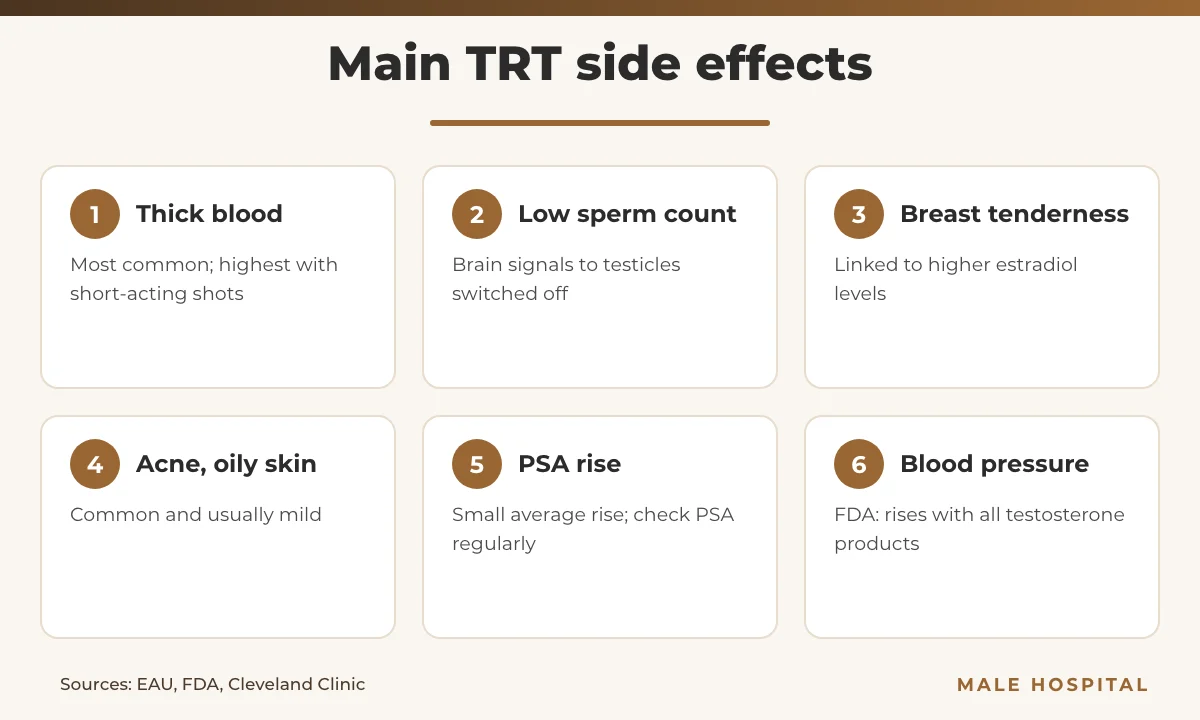
TRT side effects are common but mostly predictable: the ones doctors watch most closely are a rise in red blood cells, suppressed sperm production with smaller testicles, breast tenderness, acne, PSA and prostate changes, higher blood pressure and, less often, blood clots. Most can be caught early with blood tests and managed by changing the dose or formulation. This guide goes deeper into each side effect; for who qualifies, the forms available and the overall benefits, start with our main guide to testosterone replacement therapy.
Source: EAU — Sexual and Reproductive Health Guidelines: Male Hypogonadism; Cleveland Clinic — TRT: What It Is
- A high red blood cell count (erythrocytosis) is the most common side effect; it usually appears 3–12 months after starting and is most frequent with short-acting injections.
- TRT switches off the brain signals that drive sperm production, so sperm counts often fall to zero; in most men production returns after stopping, but it can take months.
- Breast tenderness or enlargement is linked to testosterone being converted to estradiol and is managed by adjusting the dose or formulation, sometimes with medication.
- In the large TRAVERSE trial, heart attacks and strokes were not increased, but atrial fibrillation, acute kidney injury and pulmonary embolism were more common, and the FDA now warns about raised blood pressure with all testosterone products.
- Gels can transfer to children and partners through skin contact, and long-acting undecanoate injections carry a rare risk of an oil-related coughing reaction.
- TRT side effects at a glance
- Thick blood: the most common of all TRT side effects
- Sperm production, fertility and smaller testicles
- Breast tenderness and gynecomastia
- Acne, skin reactions and gel transfer to others
- Prostate, PSA and urinary symptoms
- Blood pressure, heart rhythm and blood clots
- Injection-specific risks and POME
- Sleep apnea, mood and misuse
- When to see a doctor about TRT side effects
- FAQs about TRT side effects
TRT side effects at a glance
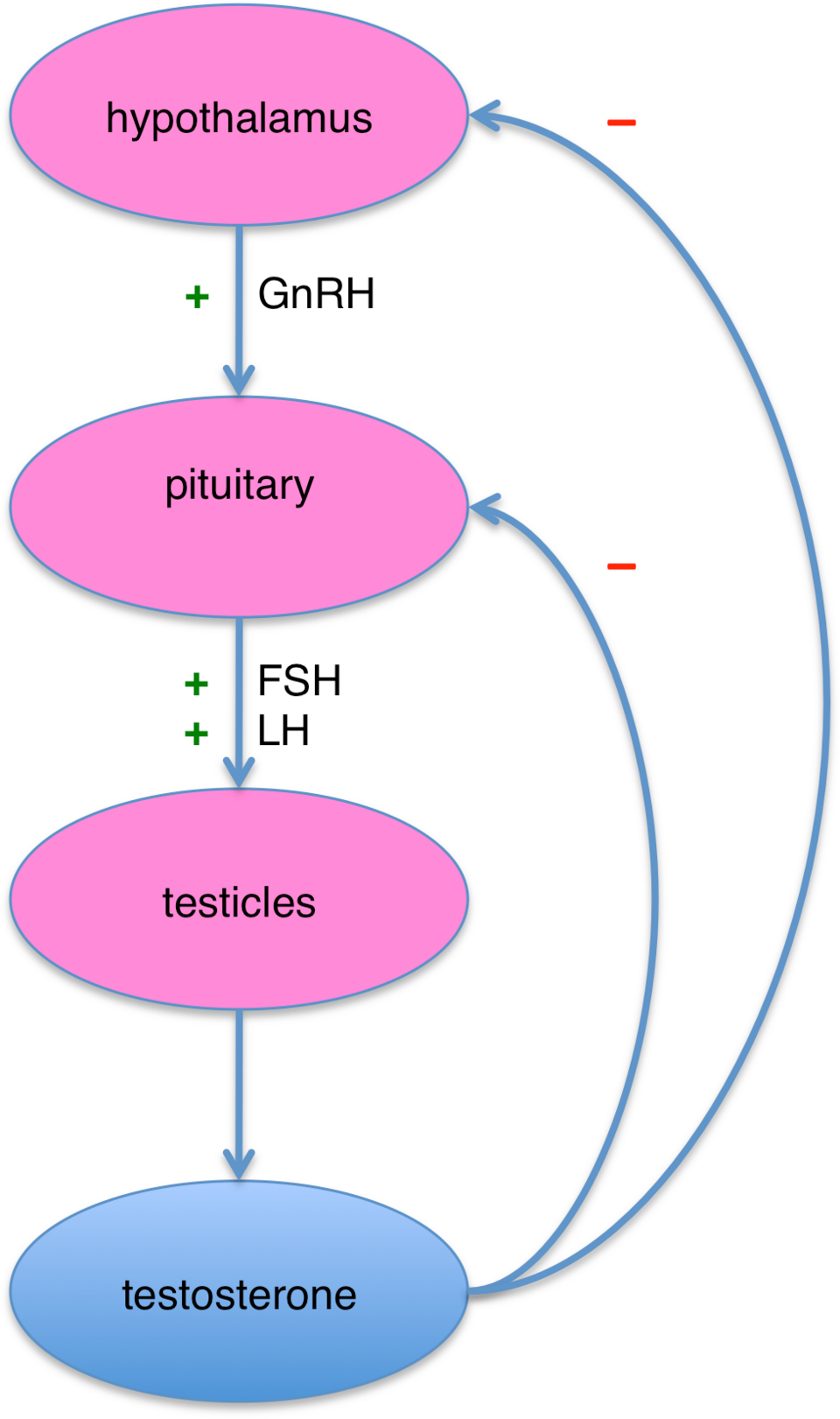
Most TRT side effects follow directly from what testosterone does in the body. It stimulates the bone marrow to make red blood cells, it is partly converted into estradiol (a form of estrogen), it acts on the prostate and the oil glands of the skin, and, because it comes from outside, it tells the brain to stop sending the hormones (LH and FSH) that keep the testicles making sperm and their own testosterone.
That is why most problems are dose-related and show up on routine blood tests before they cause harm.
| Side effect | What the evidence shows | Usual response |
|---|---|---|
| High red cell count | Most common adverse effect; highest with short-acting injections | Lower dose, switch form, blood removal if needed |
| Low sperm count, smaller testicles | Expected effect of outside testosterone | Avoid TRT if planning children; fertility-sparing options |
| Breast tenderness or enlargement | Linked to higher estradiol | Dose or form change; medication in selected men |
| Acne, oily skin, gel rash | Common, usually mild | Skin treatment; rotate or change product |
| PSA rise, urinary symptoms | Small average PSA rise; no clear rise in prostate cancer | PSA checks; urology review if PSA jumps |
| Higher blood pressure, fluid retention | Confirmed class-wide by FDA | Regular blood-pressure checks |
| Blood clots, atrial fibrillation | Slightly more frequent in TRAVERSE | Screen for clotting history; urgent care for symptoms |
| Liver problems | Mainly with older high-dose oral 17-alpha-alkyl androgens | Gels, injections or newer oral forms preferred |
Source: EAU — Sexual and Reproductive Health Guidelines: Male Hypogonadism; Int Braz J Urol (PMC) — Management of Adverse Effects in TRT (2025); DailyMed (NLM) — AndroGel 1.62% prescribing information
Thick blood: the most common of all TRT side effects
Erythrocytosis means too many red blood cells, measured as haematocrit (the percentage of the blood made up of red cells). The EAU calls it the most common adverse effect of testosterone therapy (TRT) and notes that it usually appears between 3 and 12 months after starting.
Why injections raise it more than gels
The form of testosterone matters. In a Baylor College of Medicine study of men followed for up to three years, a haematocrit above 50% occurred in 66.7% of men on injections, 35.1% on pellets and 12.8% on gels. The injection group was younger with higher baseline haematocrit, but a 2018 review in Sexual Medicine Reviews reached the same conclusion: short-acting injectable testosterone carries the highest risk.
Source: Sex Med (PubMed) — Comparison of the Effects of Testosterone Gels, Injections, and Pellets (2015); Sex Med Rev (PubMed) — Erythrocytosis Following Testosterone Therapy (2018)
What doctors do when haematocrit climbs
The EAU found no evidence of harm from a haematocrit up to and including 54%. Above that level it advises reducing the dose, switching formulation or removing about 500 mL of blood (venesection), and it urges caution when the baseline haematocrit is already 48–50%. Some urology reviews set a lower trigger and suggest therapeutic phlebotomy above 52%, and splitting injections into smaller, more frequent doses.
Untreated sleep apnea can itself push haematocrit up through repeated drops in oxygen at night, so men with snoring and daytime sleepiness are often screened before starting.
Source: EAU — Sexual and Reproductive Health Guidelines: Male Hypogonadism; Int Braz J Urol (PMC) — Management of Adverse Effects in Testosterone Replacement Therapy (2025)
Sperm production, fertility and smaller testicles
This is the TRT side effect that surprises men most. When testosterone is given from outside, the brain senses high levels and cuts LH and FSH. The testicles then make less of their own testosterone and fewer sperm, and they often become smaller and softer. Cleveland Clinic lists both smaller testicles and a lower sperm count leading to infertility as TRT side effects.
The effect can be profound. In a Canadian male-infertility clinic, 88.4% of men who were taking testosterone had no sperm at all in their semen (azoospermia).
Source: Fertil Steril (PubMed) — Testosterone use in the male infertility population (2014); Cleveland Clinic — TRT: What It Is
Does sperm production come back after stopping?
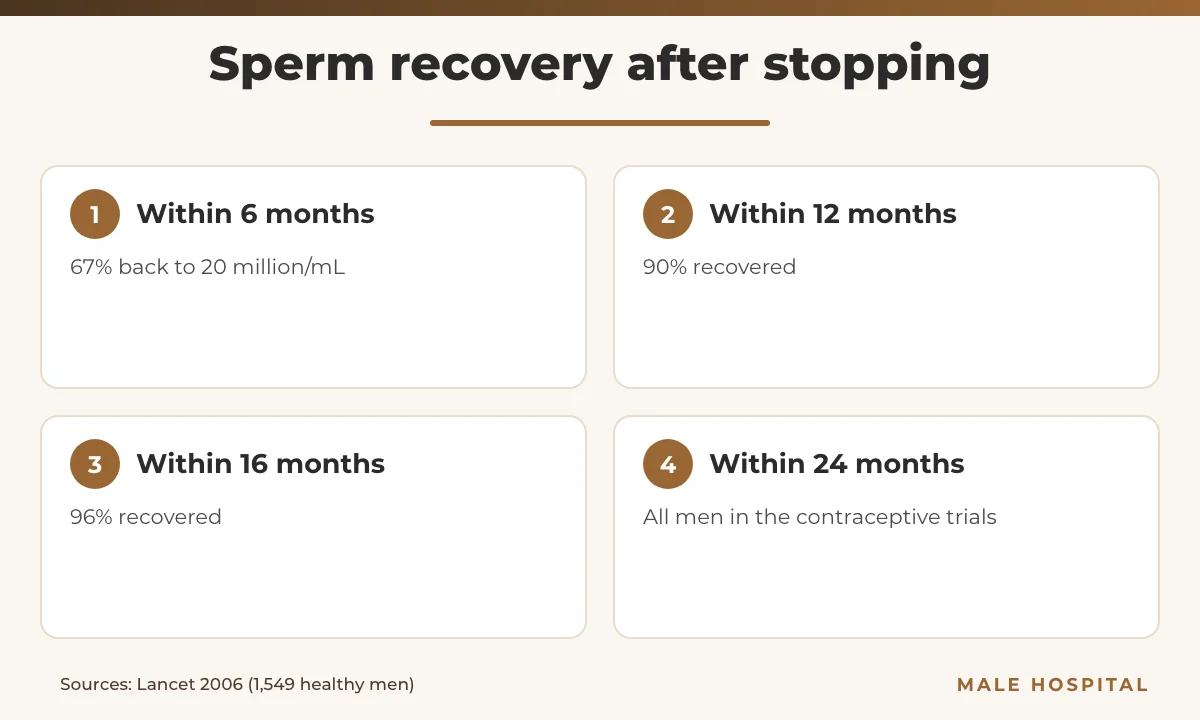
Usually, yes, but not quickly. In the same Canadian study, 65% of men with no other cause for azoospermia had recovered sperm production by 6 months after stopping. The largest data set comes from male contraceptive trials of 1,549 healthy men given testosterone-based regimens: the chance of sperm concentration returning to 20 million per mL was 67% within 6 months, 90% within 12 months, 96% within 16 months, and every man had recovered within 24 months. Recovery was faster in men who used shorter-acting preparations and for a shorter time.
These volunteers had normal hormone function, so men with true hypogonadism may recover less fully. If you may want children, tell your doctor before starting. For practical ways to support sperm health, see our guide to low sperm count. The EAU treats an active wish for fertility as a reason not to use testosterone, and hCG or clomiphene are the usual alternatives that raise testosterone while preserving sperm production. Our guide to male infertility explains the wider work-up.
Source: Lancet (PubMed) — Rate, extent, and modifiers of spermatogenic recovery after hormonal male contraception (2006); Fertil Steril (PubMed) — Testosterone use in the male infertility population (2014); EAU — Male Hypogonadism
Breast tenderness and gynecomastia
Part of any TRT dose is converted to estradiol by the enzyme aromatase. In the Baylor comparison, estradiol rose with every form of testosterone and stayed higher throughout follow-up with injections and gels. High estradiol can cause breast tenderness or enlargement (gynecomastia).
A 2025 review of TRT adverse effects notes that estradiol above 60 pg/mL may cause gynecomastia. Management steps it describes are:
- Lowering the testosterone dose or switching to a formulation with less conversion to estradiol.
- An aromatase inhibitor such as anastrozole when estradiol is clearly high (an off-label use).
- Low-dose tamoxifen for painful, symptomatic breast growth.
- Watchful waiting if estradiol is normal, because some cases settle on their own; surgery only after at least 12 months if the tissue persists and causes distress.
Breast changes in a man are not always due to TRT. The NHS lists anabolic steroid use, certain medicines, being overweight and conditions such as kidney disease and cirrhosis as other causes, and advises a medical check for any lump, persistent pain, nipple discharge or skin changes.
Source: Int Braz J Urol (PMC) — Management of Adverse Effects in Testosterone Replacement Therapy (2025); Sex Med (PubMed) — Testosterone Gels, Injections, and Pellets (2015); NHS — Gynaecomastia
Acne, skin reactions and gel transfer to others
Testosterone increases the activity of the skin’s oil glands, so oily skin and acne are common TRT side effects. Mild acne usually responds to topical retinoids or benzoyl peroxide; severe cases may need a dermatologist.
Gels and patches add their own problems. In the 182-day controlled trial of AndroGel 1.62%, contact dermatitis (skin irritation at the application site) occurred in 2.1% of men on the gel and in none on placebo.
Source: Int Braz J Urol (PMC) — Management of Adverse Effects in TRT (2025); DailyMed (NLM) — AndroGel 1.62% prescribing information
Secondary exposure: a risk to children and partners
Testosterone gel carries an FDA boxed warning because children have developed virilization after touching a parent’s treated skin. Reported signs include enlargement of the penis or clitoris, early pubic hair, increased erections and sex drive, aggressive behavior and advanced bone age. Exposed women can develop changes in hair pattern and worse acne.
To prevent it, apply gel only to the sites the label specifies, wash your hands afterward, let it dry, cover the area with clothing, and wash the skin before close contact. Stop and seek advice if a child or partner shows any of these signs.
Source: DailyMed (NLM) — AndroGel 1.62% prescribing information
Prostate, PSA and urinary symptoms
Testosterone stimulates the prostate, so PSA (prostate-specific antigen) often rises a little. In the AndroGel 1.62% trial, “PSA increased” was the most frequent adverse reaction, reported in 11.1% of men on gel versus none on placebo. A 2025 review puts the average PSA rise on TRT at about 0.30 ng/mL, and about 0.43 ng/mL in older men.
The bigger question is cancer, and here the evidence is reassuring. An EAU-cited meta-analysis of 27 placebo-controlled trials found no PSA increase after one year, and in TRAVERSE prostate cancer rates did not differ from placebo even though PSA rose more on testosterone. Testosterone remains off-limits in men with known or suspected prostate or breast cancer.
For urinary symptoms, an 8-year study of 428 men found improved symptom scores but a significant increase in prostate volume, and severe symptoms (IPSS above 19) are a relative contraindication. In June 2026 the FDA asked manufacturers to revise label safety information on prostate cancer and benign prostatic hyperplasia; the final wording had not been detailed on its page at the time of writing.
Source: EAU — Male Hypogonadism; DailyMed (NLM) — AndroGel 1.62% prescribing information; FDA — Testosterone Information
Blood pressure, heart rhythm and blood clots
Heart attacks and strokes, the old headline fear, were not increased in TRAVERSE (7.0% vs 7.3% over a mean of 33 months). What the trial did show was a higher incidence of atrial fibrillation (an irregular heart rhythm), acute kidney injury and pulmonary embolism in the testosterone group.
Source: N Engl J Med (PubMed) — Cardiovascular Safety of Testosterone-Replacement Therapy (TRAVERSE, 2023)
Blood pressure and fluid retention
The FDA reports that ambulatory blood-pressure studies confirmed a rise in blood pressure with all testosterone products, class-wide, and it now requires a blood-pressure warning on every label. In the AndroGel 1.62% trial, hypertension was reported in 2.1% of men. Testosterone can also cause fluid retention and ankle swelling, which matters most for men with heart, kidney or liver disease. Blood pressure should be checked before and during treatment.
Source: FDA — Class-wide labeling changes for testosterone products; DailyMed (NLM) — AndroGel 1.62% prescribing information
Deep vein thrombosis and pulmonary embolism
Blood clots in the legs (DVT) and lungs (PE) have been reported with testosterone. In TRAVERSE, pulmonary embolism occurred in 0.9% of men on testosterone versus 0.5% on placebo, and the AndroGel label reports venous thromboembolism in 1.7% versus 1.2%. Other large studies found no clear link, and in one, most clots occurred in men with an underlying clotting disorder. A personal or family history of clots should be discussed before starting.
Source: EAU — Male Hypogonadism; DailyMed (NLM) — AndroGel 1.62% prescribing information
Injection-specific risks and POME
TRT injections can cause pain, redness, bruising or hardness at the injection site. Long-acting testosterone undecanoate, an oil-based depot, carries one rarer risk: pulmonary oil microembolism (POME), where tiny oil droplets reach the lungs and trigger an urge to cough, shortness of breath or throat tightness during or soon after the injection.
In the United States the product is available only through a restricted program, must be given in a healthcare setting, and patients wait at least 30 minutes afterward. POME is uncommon: a post-marketing analysis found a reported rate below 0.1% per injection, with most episodes resolving within 30 minutes and most needing no treatment.
Source: MedlinePlus — Testosterone Injection; Sex Med (PubMed) — Pulmonary Oil Microembolism After Testosterone Undecanoate Injection (2020)
Sleep apnea, mood and misuse
Sleep apnea appears on many lists of TRT side effects, but the evidence is mixed. Cleveland Clinic lists worsening sleep apnea, and untreated severe sleep apnea is a reason not to start. The EAU, however, found no evidence that testosterone causes or worsens sleep apnea; one trial in severe sleep apnea showed a temporary drop in night-time oxygen at seven weeks that was gone by 18 weeks.
Mood effects run both ways. Testosterone slightly improved mood in older men with low levels, but MedlinePlus lists mood swings and trouble sleeping among common side effects, and emotional lability was reported in 2.6% of men in the AndroGel 1.62% trial. Depression, anxiety or suicidal thoughts need prompt medical attention.
Misuse is a separate problem. Testosterone is a controlled substance, and doses above the medical range carry serious heart, liver and psychiatric risks; stopping abruptly after high-dose use can cause withdrawal symptoms. Men who want to understand what normal levels look like can read our guide to normal testosterone levels by age.
Source: EAU — Male Hypogonadism; Cleveland Clinic — TRT: What It Is; MedlinePlus — Testosterone Injection
When to see a doctor about TRT side effects
While on TRT, seek urgent care for:
- Sudden shortness of breath or trouble breathing (possible blood clot in the lungs).
- Pain, swelling, warmth or redness in one leg (possible deep vein thrombosis).
- Breathing difficulty or throat tightness during or after an injection.
- Erections that are too frequent or last too long.
- Yellow skin or eyes, dark urine or pain in the upper right abdomen.
- Thoughts of self-harm or severe mood changes.
Book a prompt review for an irregular heartbeat, difficulty passing urine, blood in the urine, a breast lump, ankle swelling or high home blood-pressure readings.
Source: MedlinePlus — Testosterone Injection; N Engl J Med (PubMed) — TRAVERSE (2023)
If you are on testosterone and worried about a side effect, or want to start treatment in a way that protects your fertility, you can arrange a confidential consultation with our urologist-andrologist, Assoc. Prof. Dr. Zülfü Sertkaya, via WhatsApp.
FAQs about TRT side effects
What is the most common side effect of TRT?
A rise in red blood cells (erythrocytosis) is the most common. It usually develops 3–12 months after starting and is most frequent with short-acting injections. It causes no early symptoms, so haematocrit is checked regularly.
Source: EAU — Male Hypogonadism; Sex Med Rev (PubMed) — Erythrocytosis Following Testosterone Therapy
Do TRT side effects go away if I stop?
Most do. Red cell counts, acne and breast tenderness usually settle after stopping or adjusting the dose. Sperm production also returns in most men, but it can take 6–12 months or longer. Low-testosterone symptoms can come back once treatment ends.
Source: Lancet (PubMed) — Spermatogenic recovery after hormonal male contraception
Does TRT shrink your testicles?
It often does. Outside testosterone switches off LH and FSH, the brain hormones that stimulate the testicles, so they make less testosterone and fewer sperm and can become smaller. Sperm production usually recovers after stopping, although it can take many months. Men who want to keep fertility may be offered hCG or clomiphene instead of TRT.
Source: Cleveland Clinic — TRT: What It Is; Int Braz J Urol (PMC) — Management of Adverse Effects in TRT
Can TRT cause prostate cancer?
Current evidence does not show that it does. In TRAVERSE, prostate cancer rates were similar to placebo, and large cohort data show no increased risk, although PSA tends to rise slightly. PSA is monitored during treatment so that any sharp rise is investigated.
Source: EAU — Male Hypogonadism
Can testosterone gel affect my partner or children?
Yes. Gel can transfer through skin contact, and children exposed this way have developed genital enlargement, early pubic hair and advanced bone age; women can develop acne and hair changes. Wash your hands after applying, let the gel dry, keep the area covered and wash it before close skin contact.
Source: DailyMed (NLM) — AndroGel 1.62% prescribing information
Is POME after a testosterone injection dangerous?
POME is a coughing and breathlessness reaction to oil droplets after long-acting testosterone undecanoate injections. It is rare, reported in fewer than 0.1% of injections in post-marketing data, and most episodes clear within 30 minutes without treatment. That is why patients are observed for at least 30 minutes after each injection.
Source: Int J Impot Res (PubMed) — POME with intramuscular testosterone undecanoate: literature review (2023); MedlinePlus — Testosterone Injection
Medically reviewed by Assoc. Prof. Dr. Zülfü Sertkaya, urologist and andrologist (FEBU), Istanbul. Last reviewed: November 2026.
This article is for general information and does not replace an individual consultation with a qualified doctor.
- EAU — Sexual and Reproductive Health Guidelines: Male Hypogonadism
- Cleveland Clinic — TRT: What It Is
- DailyMed (NLM) — AndroGel 1.62% prescribing information
- Sex Med (PubMed) — Comparison of the Effects of Testosterone Gels, Injections, and Pellets (2015)
- Sex Med Rev (PubMed) — Erythrocytosis Following Testosterone Therapy (2018)
- Int Braz J Urol (PMC) — Management of Adverse Effects in Testosterone Replacement Therapy (2025)
- Fertil Steril (PubMed) — Testosterone use in the male infertility population (2014)
- Lancet (PubMed) — Rate, extent, and modifiers of spermatogenic recovery after hormonal male contraception (2006)
- NHS — Gynaecomastia
- FDA — Testosterone Information
- N Engl J Med (PubMed) — Cardiovascular Safety of Testosterone-Replacement Therapy (TRAVERSE, 2023)
- FDA — FDA issues class-wide labeling changes for testosterone products
- MedlinePlus — Testosterone Injection
- Sex Med (PubMed) — Occurrence of Pulmonary Oil Microembolism After Testosterone Undecanoate Injection (2020)
- Int J Impot Res (PubMed) — Occurrence of POME with intramuscular testosterone undecanoate injection: literature review (2023)