Enlarged prostate and erectile dysfunction often show up together in men over 50, and the link is more than age: urinary symptoms from benign prostatic hyperplasia (BPH) are an independent risk factor for erection problems. The good news is that one medicine, tadalafil 5 mg once daily, is FDA-approved to treat both at the same time, and most BPH procedures can now be chosen with your sex life in mind. For the full range of options for erections themselves, see our erectile dysfunction treatment page.
Source: PubMed — Rosen et al. 2003, Lower urinary tract symptoms and male sexual dysfunction (MSAM-7); DailyMed (FDA label) — CIALIS (tadalafil) prescribing information
- In a survey of 12,815 men aged 50 to 80, the more severe the urinary symptoms, the more common sexual problems were, regardless of diabetes, high blood pressure or heart disease.
- An enlarged prostate (BPH) and ED appear to share roots: reduced nitric oxide signaling, increased smooth muscle tension, an overactive adrenergic nervous system and pelvic atherosclerosis.
- Tadalafil 5 mg once daily is licensed for ED, for enlarged prostate (BPH) symptoms, and for both together; it improves urinary symptom scores and erectile function but not urine flow rate.
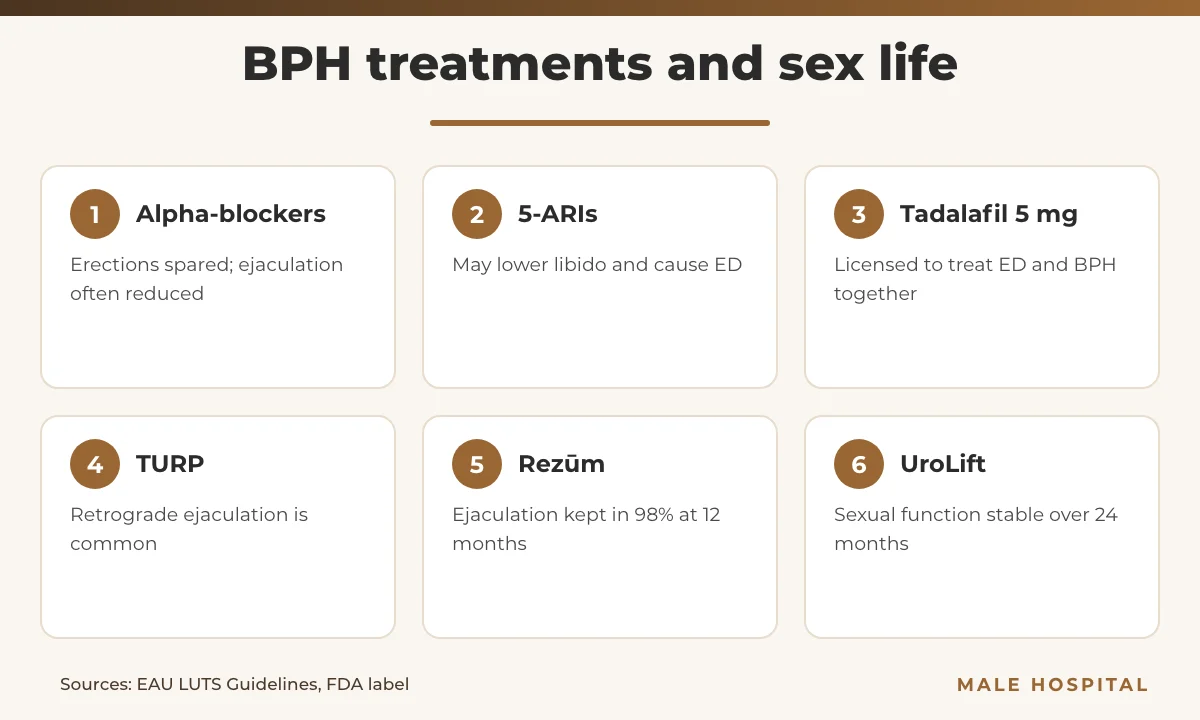
- Alpha-blockers do not harm erections or libido but often change ejaculation; 5-alpha-reductase inhibitors can lower libido and cause ED.
- Surgery such as TURP can cause retrograde ejaculation; newer options such as the prostatic urethral lift and water vapor therapy largely preserve ejaculation.
- Enlarged prostate and erectile dysfunction: how common is the overlap?
- Why BPH and ED share the same roots
- Getting assessed for both conditions
- Tadalafil 5 mg: one pill for an enlarged prostate and erectile dysfunction
- How BPH medicines affect erections and ejaculation
- Prostate procedures and your sex life
- Choosing a treatment when sexual function matters
- When to see a doctor
- FAQs about enlarged prostate and erectile dysfunction
Enlarged prostate and erectile dysfunction: how common is the overlap?
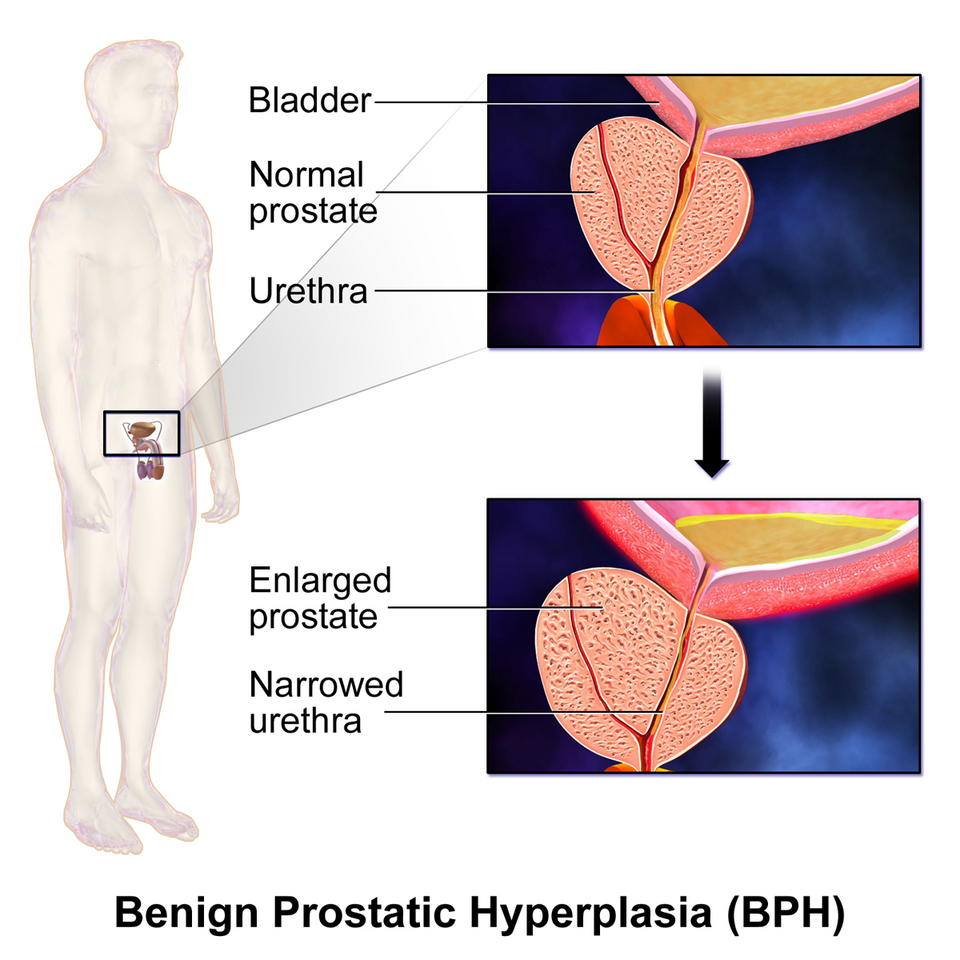
Benign prostatic hyperplasia is a noncancerous enlargement of the prostate, the walnut-sized gland that wraps around the urethra just below the bladder. As it grows, it can squeeze the urethra and cause lower urinary tract symptoms (LUTS): a weak or interrupted stream, trouble starting, dribbling, urgency, frequent urination and getting up at night to pass urine. Symptom severity does not always match the size of the prostate.
An enlarged prostate (BPH) is the most common prostate problem in men over 50. In the United States it affects about 5% to 6% of men aged 40 to 64 and about 29% to 33% of men aged 65 and older. Erectile dysfunction rises over the same decades, so many men face both at once.
Source: NIDDK — Enlarged Prostate (Benign Prostatic Hyperplasia)
The overlap is not only a matter of getting older. The Multinational Survey of the Aging Male (MSAM-7) studied 12,815 men aged 50 to 80 in the United States and six European countries. Sexual activity was common: 83% of the men reported it. Sexual problems, and how much they bothered men, were strongly related to both age and the severity of urinary symptoms. Crucially, the relationship held even after accounting for diabetes, high blood pressure, heart disease and high cholesterol, which made LUTS an independent risk factor for sexual dysfunction.
The survey also showed how rarely men speak up: although 90% of the men had some LUTS, only 19% had sought medical help for them. The European Association of Urology (EAU) now lists LUTS/BPH among the urological conditions frequently associated with ED, and expert reviews recommend that older men with urinary symptoms be asked about sexual function, and vice versa.
Source: PubMed — Rosen et al. 2003, Lower urinary tract symptoms and male sexual dysfunction (MSAM-7); EAU — Sexual and Reproductive Health Guidelines: Management of Erectile Dysfunction
Why BPH and ED share the same roots
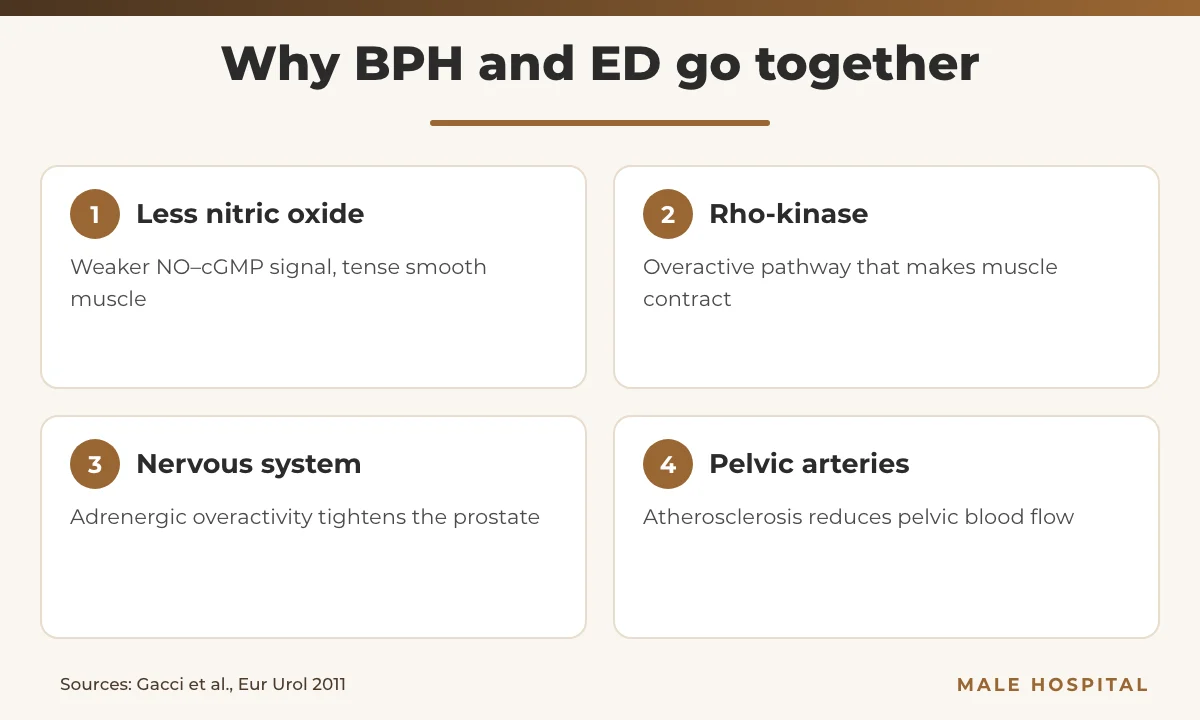
An erection depends on smooth muscle in the penis relaxing so that blood can rush in. The prostate and bladder neck are also packed with smooth muscle, and when that muscle is too tense, urine flow suffers. Researchers have proposed four shared mechanisms that can push both systems in the wrong direction at once.
1. Less nitric oxide signaling
Nitric oxide (NO) triggers the chemical messenger cGMP, which relaxes smooth muscle. When the NO–cGMP pathway weakens, the penis has trouble filling with blood and the prostate and bladder neck stay more contracted. This is exactly the pathway that PDE5 inhibitors such as tadalafil boost, which helps explain why one pill can help both an enlarged prostate and ED.
2. Overactive Rho-kinase signaling
The RhoA–Rho-kinase pathway makes smooth muscle contract. Increased activity in this pathway has been described in both erectile tissue and the lower urinary tract, adding tension where relaxation is needed.
3. Autonomic (adrenergic) hyperactivity
The sympathetic “fight or flight” nervous system tightens the prostate and bladder neck and works against erections. Heightened sympathetic tone may therefore worsen urinary symptoms and erections together.
4. Pelvic atherosclerosis
Narrowed, stiffened arteries reduce blood flow to the penis, bladder and prostate. Poor pelvic circulation is a recognized contributor to ED and is thought to play a role in bladder and prostate changes too. If you want to understand the vascular side in more depth, our guide to erectile dysfunction causes covers it in detail.
Getting assessed for both conditions
Because an enlarged prostate and ED travel together, a good assessment looks at both. Doctors use validated questionnaires to measure each problem: the International Prostate Symptom Score (IPSS) for urinary symptoms and the International Index of Erectile Function (IIEF) for erections and sexual satisfaction. These scores make it easier to track whether a treatment is actually helping.
Your doctor will also review your medicines. Some drugs make urinary symptoms worse, including decongestants, antihistamines, tranquilizers, antidepressants and diuretics, and some drugs for an enlarged prostate can themselves affect sexual function. Sharing a full list, including over-the-counter products, avoids surprises.
Source: PubMed — Rosen et al. 2003 (MSAM-7); NIDDK — Enlarged Prostate (Benign Prostatic Hyperplasia)
The EAU states that ED should be considered a precursor of cardiovascular disease, and pelvic atherosclerosis is one of the shared mechanisms above. That is why a thorough ED workup usually includes questions about heart health, blood pressure, blood sugar and cholesterol, not just the prostate.
Source: EAU — Sexual and Reproductive Health Guidelines: Management of Erectile Dysfunction
Tadalafil 5 mg: one pill for an enlarged prostate and erectile dysfunction
Tadalafil (brand name Cialis) is a PDE5 inhibitor. The FDA label lists three separate indications: erectile dysfunction, the signs and symptoms of BPH, and ED together with the signs and symptoms of BPH. For an enlarged prostate (BPH), or for ED plus BPH, the recommended dose is 5 mg taken once daily at about the same time every day, regardless of when you plan to have sex.
In the label’s 12-week trial in men with both conditions, tadalafil 5 mg improved the total IPSS by 6.1 points versus 3.8 points with placebo, and improved the IIEF erectile function score by 6.5 points versus 1.9 points with placebo. Both differences were statistically significant.
Source: DailyMed (FDA label) — CIALIS (tadalafil) prescribing information
What the guidelines say
The EAU guideline on male LUTS gives PDE5 inhibitors a strong recommendation for men with moderate to severe LUTS, with or without ED, and notes that tadalafil 5 mg once daily is the only PDE5 inhibitor licensed for LUTS. PDE5 inhibitors improve both the IPSS and the IIEF, but they do not improve maximum urine flow rate (Qmax), and the average reduction in IPSS versus placebo is small, about 1.89 points in a Cochrane analysis. The EAU erectile dysfunction guideline adds that in men over 45, about 40% were “combined responders” for both ED and LUTS after 12 weeks of daily tadalafil 5 mg.
Source: EAU — Management of Non-neurogenic Male LUTS: Disease Management; EAU — Sexual and Reproductive Health Guidelines: Management of Erectile Dysfunction
Safety points
Tadalafil must never be combined with nitrates (such as nitroglycerin or isosorbide) or with riociguat. The FDA label states that tadalafil is not recommended in combination with alpha-blockers for treating BPH, and that when it is started together with finasteride for BPH, the combination is recommended for up to 26 weeks. The EAU guidelines take a more permissive view of alpha-blocker plus PDE5 inhibitor use, but note possible additive blood pressure effects, so this is a decision for your doctor, not a do-it-yourself combination.
Common side effects include headache, back pain, muscle aches, flushing, stuffy nose and upset stomach. Seek urgent help for an erection lasting more than 4 hours or for sudden loss of vision or hearing. Dosing details, missed doses and daily versus on-demand use are covered in our article on the tadalafil daily dose, and side effects in Cialis side effects.
Source: DailyMed (FDA label) — CIALIS (tadalafil) prescribing information; Cleveland Clinic — Tadalafil Tablets (Erectile Dysfunction, BPH)
How BPH medicines affect erections and ejaculation
Many men already take a medicine for an enlarged prostate when they notice changes in their sex life. Knowing which drug does what helps you and your doctor fix the right problem instead of simply adding another pill.
Alpha-blockers (tamsulosin, silodosin, alfuzosin, doxazosin, terazosin)
Alpha-blockers, a common first treatment for an enlarged prostate, relax the muscle of the bladder neck and prostate. According to the EAU, they do not harm libido or erectile function, but they can cause abnormal ejaculation: reduced or absent semen at orgasm. The risk depends on the drug. Compared with placebo, the odds of ejaculatory problems were about 8.6 times higher with tamsulosin and 32.5 times higher with silodosin, whereas doxazosin and terazosin carried a low risk. This effect is usually unpleasant rather than dangerous, and switching drugs is often enough.
5-alpha-reductase inhibitors (finasteride, dutasteride)
These drugs help stop the growth of, or shrink, an enlarged prostate. They take time to work; MedlinePlus notes it may take at least 6 months for finasteride to improve symptoms. The most common side effects are sexual: reduced libido, erectile dysfunction and, less often, ejaculation problems such as lower semen volume. The EAU erectile dysfunction guideline lists 5-ARIs among drug causes of ED, and MedlinePlus warns that sexual side effects may occur during treatment and after it is stopped.
Source: EAU — Management of Non-neurogenic Male LUTS: Disease Management; MedlinePlus — Finasteride; EAU — Sexual and Reproductive Health Guidelines: Management of Erectile Dysfunction
Combination therapy
Adding a PDE5 inhibitor to an alpha-blocker improved the IPSS by 1.8 points, the IIEF by 3.6 points and urine flow by 1.5 mL/s compared with an alpha-blocker alone in a meta-analysis, with no serious adverse events reported. The EAU gives this combination a weak recommendation and asks doctors to tell patients that the benefit is modest.
Source: EAU — Management of Non-neurogenic Male LUTS: Disease Management
Prostate procedures and your sex life
When medicines are not enough, symptoms are severe or complications develop, a procedure may be needed. All of them aim to open the channel through the enlarged prostate, but they differ a lot in what they do to ejaculation and, to a lesser degree, to erections. Surgical treatment of BPH can cause both retrograde ejaculation and ED, so it is worth asking about sexual outcomes before you decide.
Retrograde ejaculation means semen flows backward into the bladder at orgasm. Orgasm is still felt, but little or no fluid comes out, and fertility is reduced. It is the most common sexual change after classic surgery for an enlarged prostate; our guide to retrograde ejaculation explains the symptoms, tests and fertility options in full.
Source: PubMed — Gacci et al. 2011, Critical analysis of the relationship between sexual dysfunctions and LUTS due to BPH; MedlinePlus — Transurethral resection of the prostate
| Treatment | Erections | Ejaculation |
|---|---|---|
| TURP (monopolar or bipolar) | Erection problems listed as a possible risk; IIEF similar between the two TURP types at 12 months | Retrograde ejaculation is a recognized long-term complication; anejaculation in 36% in a trial arm |
| TUIP (incision) | No specific signal in the guideline | Lower retrograde ejaculation rate than TURP, but reoperation 18.4% vs 7.2% |
| HoLEP (laser enucleation) | Comparable to TURP; long-term IIEF-5 better than TURP | Ejaculation-sparing techniques preserve it in up to 77.8% |
| GreenLight laser vaporization | IIEF-5 fell at 6, 12 and 24 months in men with good baseline function in one study | Retrograde ejaculation similar to TURP |
| Aquablation | — | Anejaculation 10% vs 36% with TURP |
| Prostatic urethral lift (UroLift) | Stable or slightly improved over 24 months | Stable or slightly improved over 24 months |
| Water vapor therapy (Rezūm) | Preserved | Antegrade ejaculation preserved in 98% at 12 months |
| Prostatic artery embolization | Lower sexual dysfunction than TURP in one analysis, but evidence uncertain | Uncertain compared with TURP |
Source: EAU — Management of Non-neurogenic Male LUTS: Disease Management; MedlinePlus — Transurethral resection of the prostate
The trade-off
Enlarged prostate procedures that best preserve ejaculation are not always the ones with the most durable results. Incision (TUIP), for example, spares ejaculation more often than TURP but needed repeat surgery more often. The prostatic urethral lift and water vapor therapy are less invasive and protect sexual function well, but they are suited to selected prostate sizes and shapes. Your urologist should explain both sides for your anatomy.
Surgery for an enlarged prostate (BPH) is different from radical prostatectomy for prostate cancer, which removes the whole gland and carries a much greater risk to erections. If you are facing cancer surgery, read our separate guide to erectile dysfunction after prostatectomy.
Source: EAU — Management of Non-neurogenic Male LUTS: Disease Management; NIDDK — Enlarged Prostate (Benign Prostatic Hyperplasia)
Choosing a treatment when sexual function matters
There is no single right answer, but a few principles help men with an enlarged prostate and erectile dysfunction make a choice that fits their priorities:
- Both problems, mild to moderate urinary symptoms: tadalafil 5 mg daily is the only licensed single treatment for both and is strongly recommended by the EAU for moderate to severe LUTS. It will not improve urine flow rate, so it suits men whose main issue is bothersome symptoms rather than obstruction.
- Ejaculation matters to you: tell your doctor. Among alpha-blockers, doxazosin and terazosin carry a lower ejaculation risk than tamsulosin or silodosin.
- Libido or erections already fragile: discuss the sexual side effects of 5-alpha-reductase inhibitors before starting one, and report any change promptly.
- Procedure needed: ask about ejaculation-preserving options such as the prostatic urethral lift, water vapor therapy, aquablation or ejaculation-sparing HoLEP, and whether your prostate size makes you a candidate.
- Planning children: mention it early, because retrograde ejaculation after surgery can reduce fertility.
Source: EAU — Management of Non-neurogenic Male LUTS: Disease Management; NIDDK — Enlarged Prostate (Benign Prostatic Hyperplasia)
If erections remain poor despite tadalafil and treatment of the prostate, the next steps are the same as for any man with ED: penile injections as a second-line option, a vacuum erection device for men who prefer drug-free treatment and, if other treatments fail, a penile implant. A past procedure for an enlarged prostate does not rule any of these out.
Source: EAU — Sexual and Reproductive Health Guidelines: Management of Erectile Dysfunction
When to see a doctor
Book a routine appointment if urinary symptoms or erection problems bother you, if a prostate medicine has changed your libido or ejaculation, or before choosing any enlarged prostate procedure. Seek urgent care if you have:
- Complete inability to pass urine
- Painful, frequent and urgent urination with fever and chills
- Blood in the urine
- Severe discomfort or pain in the lower abdomen or urinary tract
- An erection lasting more than 4 hours, or a painful erection, after taking tadalafil
- Sudden loss of vision or hearing while on tadalafil
Source: NIDDK — Enlarged Prostate (Benign Prostatic Hyperplasia); Cleveland Clinic — Tadalafil Tablets (Erectile Dysfunction, BPH)
If you would like a confidential review of your urinary symptoms and erections together, our urologist-andrologist can advise you on erectile dysfunction treatment that fits your prostate care. Send us a message on WhatsApp for a free initial consultation.
FAQs about enlarged prostate and erectile dysfunction
Can an enlarged prostate cause erectile dysfunction?
Not directly in a mechanical sense, but an enlarged prostate (BPH) and ED are closely linked. In a large survey of men aged 50 to 80, more severe urinary symptoms went with more sexual problems, independent of diabetes, high blood pressure and heart disease. Shared mechanisms such as reduced nitric oxide signaling and pelvic atherosclerosis likely explain the connection.
Source: PubMed — Rosen et al. 2003 (MSAM-7); PubMed — Gacci et al. 2011
Is tadalafil approved for both BPH and ED?
Yes. The FDA label for Cialis lists erectile dysfunction, the signs and symptoms of BPH, and both conditions together as separate indications. For BPH or ED plus BPH, the dose is 5 mg once daily at about the same time each day. It is the only PDE5 inhibitor licensed for urinary symptoms of an enlarged prostate.
Source: DailyMed (FDA label) — CIALIS (tadalafil)
Does tamsulosin cause erectile dysfunction?
According to the EAU, alpha-blockers such as tamsulosin do not adversely affect libido or erectile function. What they commonly change is ejaculation: men may notice little or no semen at orgasm. Tamsulosin and silodosin carry the highest risk of this, while doxazosin and terazosin carry a lower one. Switching drugs is often an option.
Source: EAU — Management of Non-neurogenic Male LUTS
Can finasteride cause erectile dysfunction?
Yes, it can. Reduced sex drive, difficulty getting or keeping an erection and ejaculation problems, including lower semen volume, are listed side effects of finasteride, and the EAU names 5-alpha-reductase inhibitors among drug causes of ED. MedlinePlus notes that sexual side effects may occur during treatment and after it is stopped, so report any change to your doctor.
Source: MedlinePlus — Finasteride
Will TURP affect my erections?
Erection problems are listed as a possible risk of transurethral resection of the prostate, and EAU data show erectile scores are similar after monopolar and bipolar TURP at 12 months. The more common sexual change is retrograde ejaculation, where semen enters the bladder at orgasm, which also reduces fertility. Ask your surgeon about your individual risk.
Source: MedlinePlus — Transurethral resection of the prostate; EAU — Management of Non-neurogenic Male LUTS
Which BPH procedure is best for preserving sexual function?
In EAU-reviewed trials, the prostatic urethral lift kept erectile and ejaculatory function stable or slightly better over 24 months, and water vapor therapy preserved antegrade ejaculation in 98% of men at 12 months. Aquablation and ejaculation-sparing HoLEP also protect ejaculation better than TURP. Suitability depends on the size and shape of the enlarged prostate.
Source: EAU — Management of Non-neurogenic Male LUTS
Can I take tadalafil with tamsulosin?
Only under medical supervision. The FDA label says tadalafil is not recommended together with alpha-blockers for treating BPH, and the EAU notes possible additive blood pressure effects. The EAU sees no current limitation on combining them and gives the pairing a weak recommendation for bothersome LUTS, noting the extra benefit is modest. Your doctor will decide based on your blood pressure and heart health.
Source: DailyMed (FDA label) — CIALIS (tadalafil); EAU — Management of Erectile Dysfunction
Medically reviewed by Assoc. Prof. Dr. Zülfü Sertkaya, urologist and andrologist (FEBU), Istanbul. Last reviewed: November 2026.
This article is for general information and does not replace an individual consultation with a qualified doctor.
- EAU — Management of Non-neurogenic Male LUTS — Disease Management
- EAU — Sexual and Reproductive Health Guidelines — Management of Erectile Dysfunction
- DailyMed (FDA label) — CIALIS (tadalafil) tablets — prescribing information
- NIDDK — Enlarged Prostate (Benign Prostatic Hyperplasia)
- PubMed — Rosen et al. 2003, Lower urinary tract symptoms and male sexual dysfunction: the MSAM-7 survey
- PubMed — Gacci et al. 2011, Critical analysis of the relationship between sexual dysfunctions and LUTS due to BPH
- Cleveland Clinic — Tadalafil Tablets (Erectile Dysfunction, BPH)
- MedlinePlus — Finasteride
- MedlinePlus — Transurethral resection of the prostate