
Kegel exercises for men are simple squeeze-and-relax drills for the pelvic floor muscles that support the bladder and bowel and help with erection and ejaculation. Done correctly for 6–8 weeks or more, they can reduce urine leakage, stop after-dribble and, in small trials, improve erections and ejaculatory control. This guide focuses on technique, step-by-step programs and what the evidence really shows; for the wider picture of physical activity and erections, see our guide to exercises for erectile dysfunction.
Source: Cleveland Clinic — Kegels for men: benefits and how to do them
- Find the right muscles first: the ones you would use to hold in gas or lift the scrotum, while the buttocks, thighs and belly stay relaxed.
- A typical starting program is a 5-second squeeze and 5-second rest, 10 times, 3 times a day, building to 10-second holds.
- Most men notice changes after 6–8 weeks; leakage may take several months, and benefits fade if you stop.
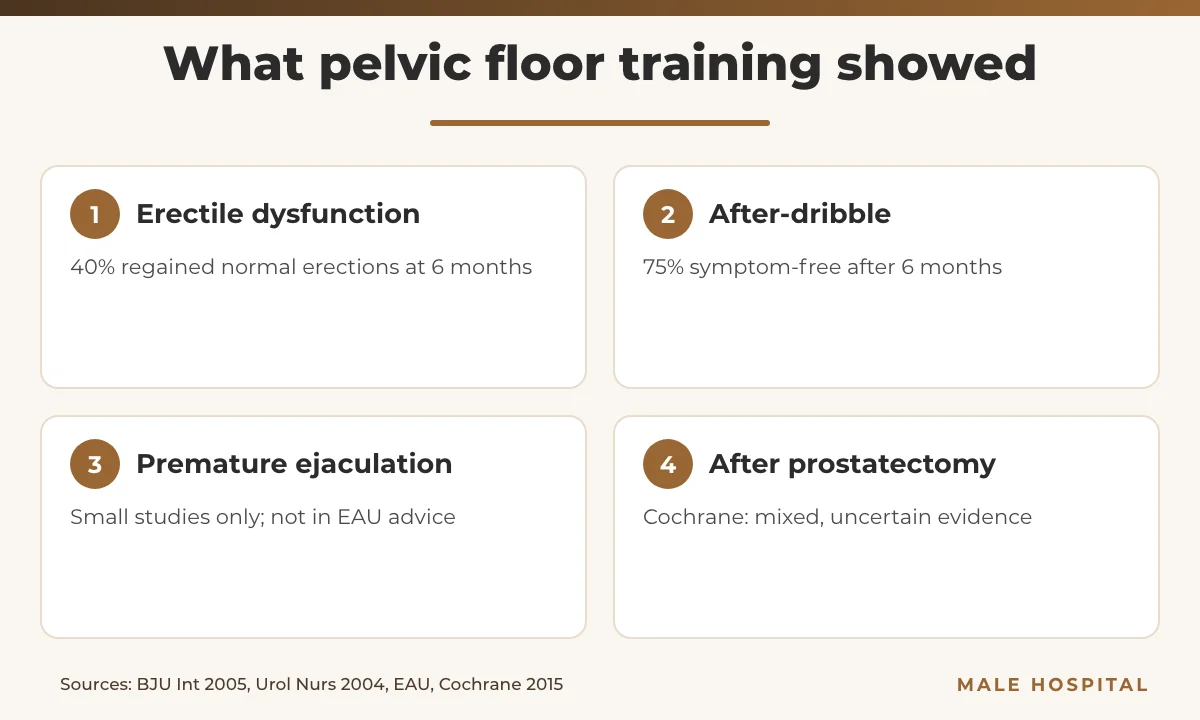
- In a randomized trial, 40% of men with erectile dysfunction regained normal erections after pelvic floor training with lifestyle advice, but evidence for premature ejaculation is still limited.
- Do not practice by stopping your urine stream, never exercise with a urinary catheter in place, and stop if you feel pain.
- What are Kegel exercises for men?
- How to find the right muscles
- How to do Kegel exercises step by step
- Kegel programs for beginners and beyond
- Kegel exercises for men with erectile dysfunction
- Kegels for premature ejaculation
- Kegels for leakage, dribbling and after prostate surgery
- Common mistakes and safety
- When to see a doctor
- FAQs about Kegel exercises for men
What are Kegel exercises for men?
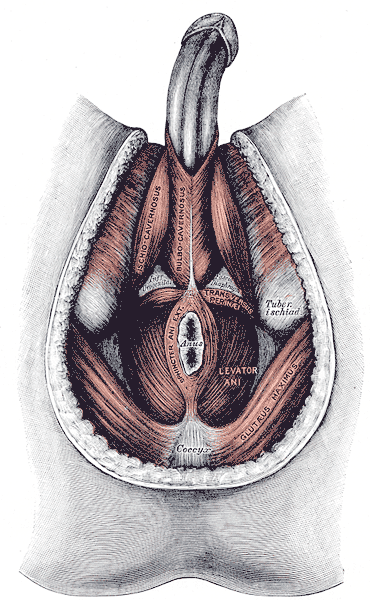
The pelvic floor is a sling of muscles at the bottom of the pelvis, running from the pubic bone to the tailbone. In men it supports the bladder and bowel, helps close the urethra and anus, and includes the muscles around the base of the penis that are active during erection and ejaculation. A Kegel is a deliberate contraction of these muscles followed by full relaxation.
Training these muscles works like any strength program: learn the movement, repeat it regularly and gradually hold longer. Kegel exercises need no equipment.
Cleveland Clinic lists several reasons men are taught Kegel exercises: urine leakage, stool leakage, symptoms linked to prostatitis or an enlarged prostate, preparation for and recovery after prostate surgery, better control over ejaculation and support for erections.
Source: Cleveland Clinic — Kegels for men: benefits and how to do them
How to find the right muscles
Most failures come from squeezing the wrong muscles, so spend your first sessions just locating them. Try one of these cues:
- The gas cue: imagine you are trying to stop yourself from passing wind. The inward squeeze and lift you feel around the back passage is the pelvic floor.
- The urine cue: imagine stopping the flow of urine mid-stream. MedlinePlus says you can test this once while actually urinating to identify the muscles, but it should not become your exercise.
- The scrotum cue: tighten the muscles that draw the scrotum up toward the body. Many men see the base of the penis move slightly as well.
- The finger check: if unsure, insert a lubricated finger into the rectum and squeeze. A correct contraction tightens and lifts around the finger, then lets go.
While you squeeze, your buttocks, inner thighs and belly should stay still and you should keep breathing. If your buttocks clench or you hold your breath, you are recruiting the wrong muscles.
Sources: Cleveland Clinic — Kegels for men; MedlinePlus — Kegel exercises: self-care
If you still cannot feel a contraction, a physical therapist trained in pelvic floor therapy can check your technique. Biofeedback, which uses sensors to show your muscle contractions on a screen, or electrical stimulation can help you learn to do Kegel exercises correctly.
Source: NIDDK — Treatments for Bladder Control Problems (Urinary Incontinence)
How to do Kegel exercises step by step
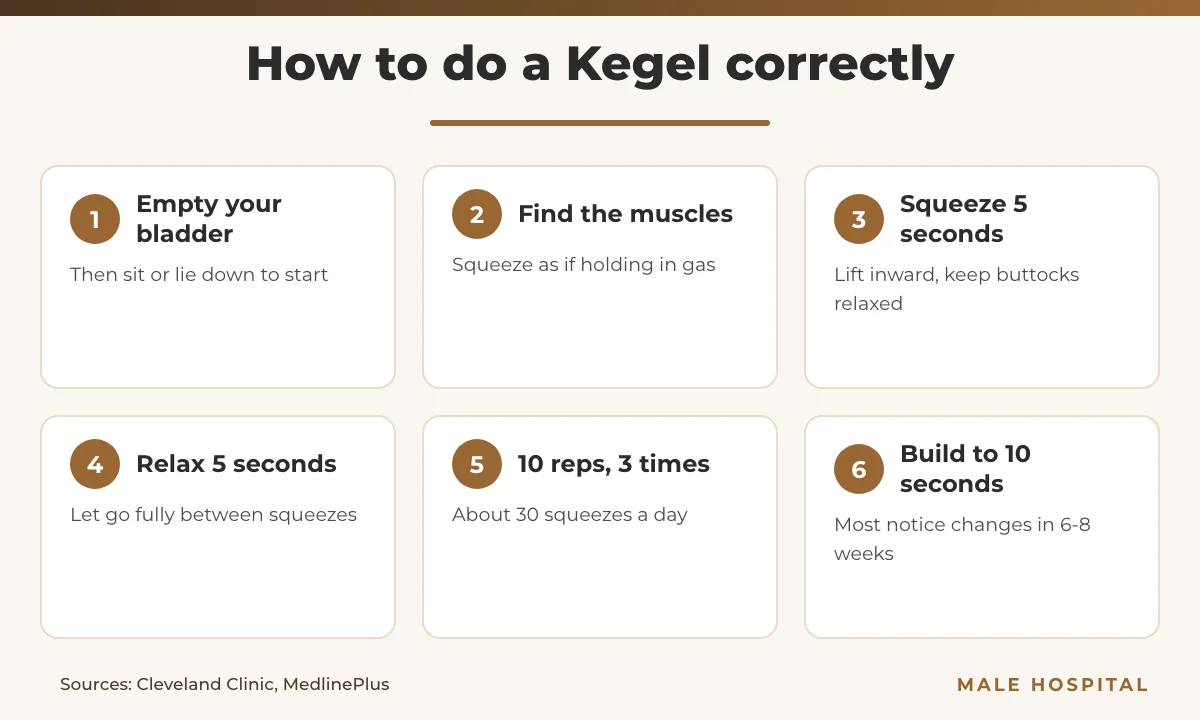
Once you can find the muscles, the basic technique for Kegel exercises recommended by Cleveland Clinic and MedlinePlus is straightforward:
- Empty your bladder. Exercising with a full bladder is uncomfortable and makes it harder to focus.
- Get into position. Start sitting with your feet flat and back supported, or lie on your back or side. These positions make the muscles easier to isolate.
- Squeeze and lift. Tighten the pelvic floor, drawing inward and upward, and hold for about 5 seconds (3–5 seconds if that is all you can manage).
- Let go completely. Relax for the same length of time. The relaxation phase matters as much as the squeeze.
- Breathe and count aloud. Counting out loud stops you from holding your breath.
- Repeat. Do 10 repetitions per session, about three sessions a day: morning, afternoon and evening.
Over the following weeks, work up to 10-second squeezes with 10-second rests. Once you are confident, you can do Kegel exercises anywhere: at your desk, while driving or watching TV. Stop a session if your muscles feel tired; a few good contractions beat many sloppy ones.
Sources: Cleveland Clinic — Kegels for men; MedlinePlus — Kegel exercises: self-care
Kegel programs for beginners and beyond
There is no single proven “best” program. A 2019 systematic review of ten trials in men with erectile dysfunction or premature ejaculation found that protocols varied widely in therapist contact, length, frequency and intensity, and that no optimal routine has been identified. The plan below is therefore built from published patient guidance and the protocols used in trials, not from a fixed formula.
| Stage | What to do | Goal |
|---|---|---|
| Learning (first days) | Locate the muscles lying down; a few 3–5 second squeezes with full rests | Correct muscle, no breath-holding, no buttock clench |
| Beginner (weeks 1–2) | 5-second hold, 5-second rest, 10 times, 3 sessions a day | 30 good contractions a day |
| Building (weeks 3–8) | Lengthen holds and rests toward 10 seconds; practice sitting and in daily life | Endurance; first changes often seen at 6–8 weeks |
| Program length | For leakage, NHS advises at least 8 contractions, 3 times a day, for at least 3 months | Measurable symptom change |
| Maintenance | Keep a regular routine; MedlinePlus advises not increasing repetitions once symptoms improve | Keep the benefit, which can fade if you stop |
| For after-dribble | Add a strong “squeeze out” contraction straight after urinating | Empty the urethra fully |
Sources: NHS — Urinary incontinence: non-surgical treatment; MedlinePlus — Kegel exercises: self-care
How long until Kegel exercises work?
Cleveland Clinic says most people notice changes after 6–8 weeks of regular practice, and MedlinePlus says symptoms should ease after 4–6 weeks, although incontinence can take several months. In the main erectile dysfunction trial, men trained for 3 months with a therapist and then continued at home for another 3 months. Because the benefit can fade when you stop, think of Kegel exercises as a long-term habit rather than a short course.
Sources: Cleveland Clinic — Kegels for men; PubMed — Dorey et al. 2005, Pelvic floor exercises for erectile dysfunction
Kegel exercises for men with erectile dysfunction
The best-known study is a UK randomized controlled trial of 55 men who had erectile dysfunction for at least six months. One group received pelvic floor exercises taught by a physiotherapist, with biofeedback and lifestyle advice; the other received lifestyle advice only. After 3 months, erectile function was significantly better in the exercise group, and control men who then switched to exercises also improved. After 6 months, blinded assessment found that 40% of men had regained normal erectile function, 35.5% had improved and 24.5% had not improved.
Source: PubMed — Dorey et al. 2005, Pelvic floor exercises for erectile dysfunction (BJU Int)
The 2019 systematic review found that all included ED trials showed improvement with pelvic floor training. However, the studies were of low to moderate quality and too different to pool. The European Association of Urology (EAU) guidelines strongly recommend lifestyle changes and risk-factor control for erectile dysfunction. In the context of rehabilitation after prostate surgery, they describe pelvic floor training with biofeedback as a promising option that still needs well-powered trials.
Sources: PubMed — Myers & Smith 2019 systematic review; EAU Guidelines — Management of erectile dysfunction
In practice, Kegel exercises are a reasonable, low-risk add-on for mild erectile dysfunction, but they do not treat the causes behind most cases, such as blood-vessel disease, diabetes or low testosterone. Men with moderate or severe ED usually need a proper assessment and medical erectile dysfunction treatment, and pelvic floor training can be used alongside it.
Kegels for premature ejaculation
The muscles you train with Kegel exercises are involved in the ejaculation reflex, which is why researchers have tested pelvic floor rehabilitation for lifelong premature ejaculation. In an Italian study of 40 men with ejaculation within one minute, 12 weeks of pelvic floor rehabilitation led 33 of them (82.5%) to gain control of the reflex. Their average time to ejaculation rose to about 146 seconds. Only 13 men were reassessed at 6 months, and their improvement had partly held.
A small randomized study by the same group compared 12 weeks of pelvic floor rehabilitation with on-demand dapoxetine. Of 19 men in the rehabilitation group, 11 (57%) could control ejaculation, with an average time of about 127 seconds. In the dapoxetine groups, 62.5% on 30 mg and 72% on 60 mg reached more than 180 seconds.
Be realistic about these numbers. The studies are small and come largely from one research group, and the current EAU guidelines on ejaculatory disorders do not list pelvic floor training among recommended treatments for premature ejaculation. The EAU does support behavioral methods such as the start-stop technique combined with psychoeducation and mindfulness, usually alongside medication. Kegel exercises can sit within that broader plan, which our guides on how to last longer in bed and premature ejaculation treatment explain.
Source: EAU Guidelines — Disorders of ejaculation
Kegels for leakage, dribbling and after prostate surgery
Urine leakage
Pelvic floor muscle training is a first step for urinary incontinence. The NHS says research shows it can benefit everyone with incontinence, and recommends a program of at least 8 contractions, 3 times a day, for at least 3 months, ideally designed by a specialist who first checks how well you can contract the muscles.
Source: NHS — Urinary incontinence: non-surgical treatment
After-dribble (post-micturition dribble)
Many men notice a few drops leaking into their underwear shortly after they finish urinating. In a randomized trial of 55 men with erectile dysfunction, 36 had this problem at the start. After pelvic floor exercises that included a strong “squeeze out” contraction right after urinating, 75% of them no longer had after-dribble at 6 months.
Before and after prostate surgery
Kegel exercises are widely taught before and after radical prostatectomy. The evidence is mixed, however. A 2015 Cochrane review of 50 trials found that men’s symptoms improved over time whatever the management. In men who already had leakage, eight trials showed no clear advantage for pelvic floor training over control at 12 months. When trials that started training in all men after surgery were combined, there was moderate evidence of less incontinence at one year (10% vs 32%), although pad-test data did not confirm this and the trials had methodological limits.
If you are having prostate surgery, ask your surgical team when to start and stop. You should never do Kegel exercises while a urinary catheter is in place, because this can cause bleeding or bladder spasms. Erection recovery after surgery is a separate topic covered in our guide to erectile dysfunction after prostatectomy.
Source: Cleveland Clinic — Kegels for men
Common mistakes and safety
Kegel exercises are low risk, but doing them badly wastes weeks and can occasionally make symptoms worse. Watch for these problems:
- Squeezing the wrong muscles: clenching the buttocks, thighs or abs instead of the pelvic floor. Pain in the lower back, stomach or head after a session suggests poor technique or breath-holding.
- Holding your breath: count aloud to keep breathing.
- Exercising while urinating: MedlinePlus advises against practicing Kegel exercises during urination more than twice a month, as this can weaken the muscles over time or harm the bladder and kidneys.
- Overdoing it: too many Kegels can increase muscle tension, and overtraining can cause straining when passing urine or stool.
- Skipping the relaxation phase: every squeeze should be followed by a full release.
Sources: Cleveland Clinic — Kegels for men; MedlinePlus — Kegel exercises: self-care
When the problem is a tight pelvic floor
Not every pelvic floor problem comes from weak muscles. In pelvic floor dysfunction, the body keeps tightening these muscles instead of relaxing them, and men may have pelvic, genital or rectal pain, constipation or difficulty with erections. Here, more squeezing is not the answer. Treatment focuses on biofeedback, physical therapy to stretch the muscles and improve coordination, and relaxation techniques.
Source: Cleveland Clinic — Pelvic Floor Dysfunction
When to see a doctor
Kegel exercises are a self-help tool, not a diagnosis. See a doctor before relying on them, or if any of the following applies:
- Kegels cause pain, or your symptoms have not improved after 6–8 weeks of correct practice.
- You have new erection problems, especially if you also have diabetes, heart disease or risk factors such as high blood pressure or smoking.
- You see blood in your urine or semen, have pain or burning when you urinate, or have a fever with pelvic pain.
- You suddenly cannot pass urine, or leakage started after surgery or an injury.
- You have leakage together with numbness in the groin, leg weakness or new bowel problems.
A specialist can confirm the cause, check your technique and refer you to a pelvic floor physical therapist if needed.
Sources: Cleveland Clinic — Kegels for men; EAU Guidelines — Management of erectile dysfunction
If erection, ejaculation or bladder symptoms are affecting your life, you can arrange a confidential consultation with our urologist-andrologist, Assoc. Prof. Dr. Zülfü Sertkaya, through WhatsApp. He can check whether pelvic floor training is right for you and combine it with erectile dysfunction treatment when needed.
FAQs about Kegel exercises for men
Do Kegel exercises for men really work?
For urine leakage and after-dribble, there is reasonable evidence they help, and NHS guidance recommends at least 3 months of training. For erectile dysfunction, a randomized trial found that 40% of men regained normal erections after 6 months, with another 35.5% improving. Evidence for premature ejaculation is promising but comes from small studies.
Sources: NHS — Urinary incontinence: non-surgical treatment; PubMed — Dorey et al. 2005
How many Kegels should a man do a day?
A common starting routine for Kegel exercises is 10 squeezes per session, three sessions a day, for about 30 contractions daily. Hold each for about 5 seconds and rest for 5, then build up to 10 seconds each. Quality matters more than quantity: stop if the muscles tire, and avoid adding more repetitions once symptoms have settled.
Sources: Cleveland Clinic — Kegels for men; MedlinePlus — Kegel exercises: self-care
How long does it take for Kegels to improve erections?
Expect weeks to months, not days. Most people notice changes after about 6–8 weeks of regular practice. In the main erectile dysfunction trial, men were assessed after 3 months of supervised training and again after a further 3 months of home exercise, when the best results were recorded.
Sources: Cleveland Clinic — Kegels for men; PubMed — Dorey et al. 2005
Can Kegels help me last longer in bed?
Possibly. Small Italian studies found that 12 weeks of pelvic floor rehabilitation helped many men with lifelong premature ejaculation gain control, but the evidence is limited and the EAU does not list it among recommended treatments. Behavioral methods such as start-stop, often combined with medication, have stronger support.
Sources: PubMed — Pastore et al. 2014; EAU Guidelines — Disorders of ejaculation
Is it OK to do Kegels while peeing?
Only to find the right muscles at the start. MedlinePlus advises against practicing Kegel exercises while urinating more than twice a month, because doing so regularly can weaken the pelvic floor over time or affect the bladder and kidneys. Do your sessions with an empty bladder instead.
Source: MedlinePlus — Kegel exercises: self-care
Can you do too many Kegels?
Yes. Overdoing Kegel exercises can raise pelvic muscle tension, worsen symptoms or cause straining when passing urine or stool. Pain in the lower back, abdomen or head after a session suggests the wrong muscles or breath-holding. Men whose pelvic floor is already too tight need relaxation-focused therapy rather than extra squeezing.
Sources: Cleveland Clinic — Kegels for men; Cleveland Clinic — Pelvic Floor Dysfunction
Should I do Kegels after prostate surgery?
They are commonly advised, but follow your surgeon’s timing and never do them with a catheter in place. A Cochrane review found mixed evidence: symptoms improve over time in most men regardless of treatment, and the benefit of training for men who already leak is uncertain, though programs started in all men after surgery showed some benefit.
Sources: Cochrane via PubMed — Anderson et al. 2015; Cleveland Clinic — Kegels for men
Do I need biofeedback or a physical therapist?
Not always, but they help if you cannot feel the muscles working or see no progress. A pelvic floor physical therapist can check your contraction and build your program, and biofeedback sensors show whether you are squeezing correctly. The successful erectile dysfunction trial used physiotherapist teaching with biofeedback.
Sources: NIDDK — Treatments for Bladder Control Problems; PubMed — Dorey et al. 2005
Medically reviewed by Assoc. Prof. Dr. Zülfü Sertkaya, urologist and andrologist (FEBU), Istanbul. Last reviewed: November 2026.
This article is for general information and does not replace an individual consultation with a qualified doctor.
- Cleveland Clinic — Kegel Exercises for Men: Benefits & How To Do Them
- MedlinePlus — Kegel exercises – self-care
- NIDDK — Treatments for Bladder Control Problems (Urinary Incontinence)
- NHS — Urinary incontinence – Non-surgical treatment
- EAU — Sexual and Reproductive Health Guidelines — Management of erectile dysfunction
- EAU — Sexual and Reproductive Health Guidelines — Disorders of ejaculation
- Cleveland Clinic — Pelvic Floor Dysfunction
- PubMed — BJU Int 2005 — Dorey et al. Pelvic floor exercises for erectile dysfunction
- PubMed — Urol Nurs 2004 — Dorey et al. Pelvic floor exercises for treating post-micturition dribble in men with erectile dysfunction: a randomized controlled trial
- PubMed — Physiotherapy 2019 — Myers & Smith. Pelvic floor muscle training improves erectile dysfunction and premature ejaculation: a systematic review
- PubMed — Ther Adv Urol 2014 — Pastore et al. Pelvic floor muscle rehabilitation for patients with lifelong premature ejaculation: a novel therapeutic approach
- PubMed — Int J Androl 2012 — Pastore et al. A prospective randomized study to compare pelvic floor rehabilitation and dapoxetine for treatment of lifelong premature ejaculation
- Cochrane Database Syst Rev 2015 — Anderson et al. Conservative management for postprostatectomy urinary incontinence