Sexual performance anxiety is worry, fear or embarrassment about how you will “perform” in bed that ends up getting in the way of sexual interest, arousal or pleasure. In men it commonly shows up as erections that fade or ejaculation that comes too fast, and it tends to feed itself: one bad experience makes the next one more stressful. It is common and treatable, and this practical guide focuses on what you can actually do before, during and after sex; for the wider medical picture of mind-related erection problems, read our main guide to psychological erectile dysfunction.
Sources: Cleveland Clinic — How to overcome performance anxiety in sex (Health Essentials 2024); PMC — ESSM position statements: Different faces of anxiety in sexual dysfunction (Sex Med 2025)
- Performance anxiety in sex is not a formal diagnosis, but reviews estimate that it affects roughly 9–25% of men.
- Anxiety activates the body’s “fight or flight” system, which narrows blood vessels in the pelvis and works against an erection.
- The problem is kept going by a loop of worry, self-monitoring during sex (“spectatoring”), a weaker response and more worry.
- Practical steps that break the loop include taking the pressure off intercourse, talking openly with your partner, slow breathing and shifting attention to sensation.
- When self-help is not enough, cognitive behavioral therapy (CBT), sex therapy with sensate focus and, for some men, short-term erection medicine can help. A medical check rules out physical causes.
- What is sexual performance anxiety?
- How anxiety switches off an erection
- Signs and common triggers
- Performance anxiety, erections and early ejaculation
- How to overcome sexual performance anxiety: a step-by-step plan
- Talking to your partner
- Professional treatment options
- Can erection pills help with performance anxiety?
- When to see a doctor
- FAQs about sexual performance anxiety
What is sexual performance anxiety?
The European Society for Sexual Medicine (ESSM) describes sexual performance anxiety as a sense of unease and apprehension that you will not measure up to some expectation in a future sexual encounter. It has three parts: an expectation (how you think you “should” perform), an evaluation (the feeling that you are being judged by your partner, by yourself or against an outside benchmark) and feared consequences (embarrassment, shame or losing the relationship).
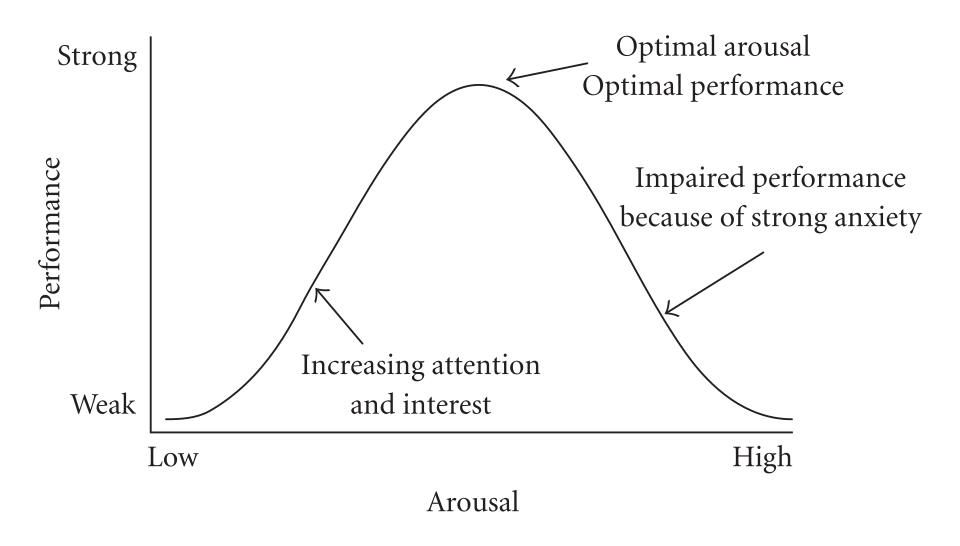
Athletes, musicians and public speakers know the same pattern. A small amount of tension can sharpen focus, but too much drags performance down, which is the “inverted U” shown in the diagram above. The ESSM statement notes that keeping anxiety at a moderate level is consistent with the best performance in this classic model.
Source: PMC — ESSM position statements: Different faces of anxiety in sexual dysfunction (Sex Med 2025)
How common is it?
There is no official medical diagnosis for this problem, which is one reason it has been studied less than you might expect. A 2020 review in Sexual Medicine Reviews estimated that it affects 9–25% of men and 6–16% of women, and concluded that it causes or maintains most common sexual dysfunctions. The ESSM adds that older surveys suggest about 5–25% of people report anxiety around sex, slightly more often men and younger people.
Sources: PubMed — Pyke, review of sex-related performance anxiety (Sex Med Rev 2020); PMC — ESSM position statements (Sex Med 2025)
How anxiety switches off an erection
An erection depends on blood vessels in the penis relaxing and filling with blood. Anxiety pushes the nervous system in the opposite direction. According to the ESSM, anxious states are dominated by the sympathetic (“fight or flight”) nervous system, which diverts blood toward large muscles and causes the vessels of the genital and pelvic region to constrict. That vasoconstriction counters the vessel widening an erection needs.
The mind matters as much as the blood vessels. Psychologist David Barlow’s model, summarized by the ESSM, explains why the same nervous energy can boost arousal in one man and wreck it in another. Men without sexual problems tend to focus on erotic cues. Men with performance anxiety focus on the consequences of failure, expect to fail and feel out of control, so their arousal turns into anxiety, the erection weakens and they start avoiding sex.
Source: PMC — ESSM position statements: Different faces of anxiety in sexual dysfunction (Sex Med 2025)
Spectatoring: watching yourself instead of feeling
“Spectatoring” means mentally stepping outside the moment to monitor yourself: “Is it hard enough? What is she or he thinking? Am I about to finish?” The ESSM lists this strong self-focus as a key individual factor because it distracts from the natural erotic cues of your partner and the situation. In a preregistered study of 858 sexually active men, worries about the appearance of the penis were linked with more spectatoring, which in turn was linked with more erection and orgasm problems.
Sources: PMC — ESSM position statements (Sex Med 2025); PubMed — Wyatt & de Jong, Penis appearance concerns, spectatoring and sexual difficulties (Arch Sex Behav 2020)
The anxiety loop
Each disappointing experience tends to bring guilt, embarrassment or shame, and worry about the next encounter. The ESSM notes that this worry and the negative self-talk that comes with it are likely to keep the problem going, sometimes until a man avoids intimacy altogether. The loop can be broken at several points, which is what the plan below is designed to do.
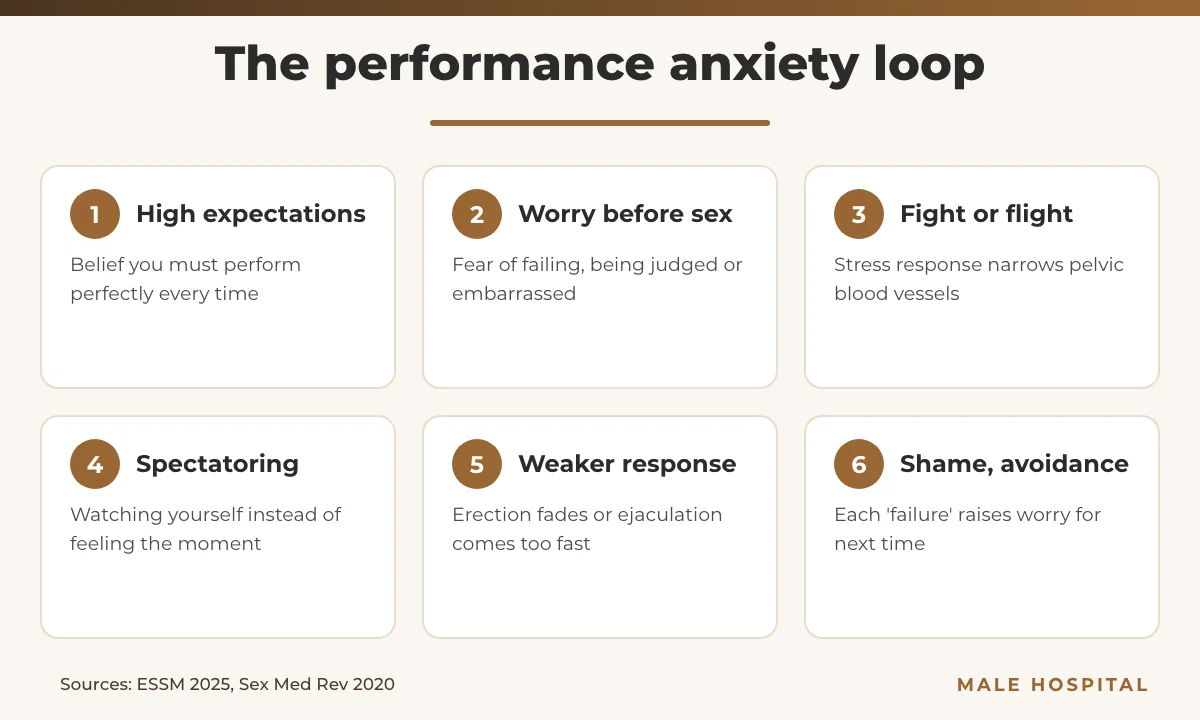
Source: PMC — ESSM position statements: Different faces of anxiety in sexual dysfunction (Sex Med 2025)
Signs and common triggers
Cleveland Clinic describes the experience as racing thoughts and difficulty getting into the moment. In practice, men often notice some of the following:
- Erections that are fine during masturbation or on waking but fade with a partner.
- Ejaculating sooner than wanted, or, less often, being unable to reach orgasm.
- Dreading sex in advance, or finding reasons to avoid it.
- Constant checking of the erection and of your partner’s reactions during sex.
- Less interest in sex over time.
Common triggers include a new partner, past sexual disappointments, body image worries (including penis size concerns), relationship tension, past trauma or abuse, and general stress. The ESSM adds individual factors such as very high or unrealistic expectations, harsh self-criticism, low confidence, and cultural “macho” beliefs about how a man should perform.
Sources: Cleveland Clinic — How to overcome performance anxiety in sex (Health Essentials 2024); PMC — ESSM position statements (Sex Med 2025)
Occasional erection problems are very common: the NHS notes that they are usually caused by stress, tiredness or drinking too much alcohol. Frequent problems are different and can point to conditions such as high blood pressure, diabetes, hormone problems, depression or anxiety. Young men are not exempt, as our article on erectile dysfunction in young men explains.
Source: NHS — Erection problems (erectile dysfunction)
Performance anxiety, erections and early ejaculation
Performance anxiety can show up in different ways, and it often overlaps with other conditions. The 2020 review found that it contributes both to premature ejaculation and to psychogenic (mind-related) erectile dysfunction. European urology guidelines state that acquired premature ejaculation may occur because of psychological problems such as sexual performance anxiety, and that high performance anxiety related to erection problems may worsen premature ejaculation. The NHS also lists anxiety about sexual performance among common psychological causes of premature ejaculation, especially early in a new relationship or after earlier problems.
| How it shows up | What often happens | Practical first steps |
|---|---|---|
| Erection fades with a partner | Worry and self-monitoring trigger the “fight or flight” response; erections alone or on waking may still be normal | Pause intercourse goals, sensate focus, slow breathing, medical check |
| Ejaculating too quickly | Anxiety, especially with a new partner or after earlier problems, may contribute to acquired premature ejaculation | Stop-start or squeeze technique, psychosexual counseling, assess for ED |
| Avoiding sex | Anticipatory worry after repeated “failures” leads to avoidance of intimacy | Honest talk with your partner, non-demand touch, therapy |
Sources: PubMed — Pyke, review of sex-related performance anxiety (Sex Med Rev 2020); EAU Guidelines — Disorders of ejaculation; NHS — Ejaculation problems; Cleveland Clinic — How to overcome performance anxiety in sex (Health Essentials 2024)
If early ejaculation is your main concern, our guide on how to last longer in bed covers the techniques in detail.
How to overcome sexual performance anxiety: a step-by-step plan
The ESSM says treatment can target the anxiety itself, the thought patterns that keep it going, or both, and that it helps to strengthen the “automatic” mode of sexual response instead of the deliberate, watchful mode. The steps below put that into everyday practice. They are low-risk, but they work best alongside a medical check, not instead of one.
Source: PMC — ESSM position statements: Different faces of anxiety in sexual dysfunction (Sex Med 2025)
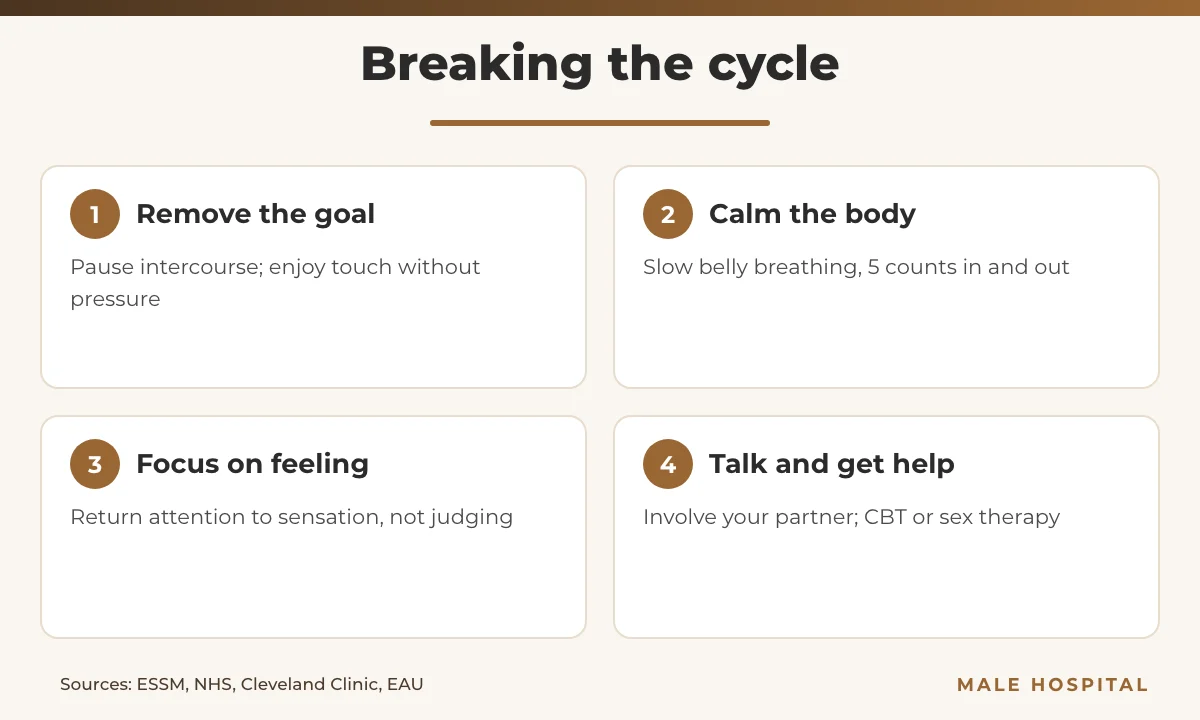
Step 1: Take intercourse off the table for a while
Pressure to achieve penetration is the engine of the anxiety loop. Agree with your partner on a period when sex means touching, kissing and exploring without the goal of intercourse. Cleveland Clinic suggests learning about sexual response and exploring pleasure beyond penetration, using hands, mouth or toys, which can reduce anxiety about performance. When an erection is no longer “required,” it often returns on its own.
Step 2: Calm the body before and during intimacy
Because anxiety is a body state, a body-based skill helps. The NHS breathing exercise for stress is simple: breathe in gently through your nose into your belly while counting from 1 to 5, then breathe out through your mouth, again counting to 5, and continue for at least 5 minutes. The NHS notes you will get the most benefit by practicing it regularly as part of your daily routine, so the skill is ready when you need it.
Sources: Cleveland Clinic — How to overcome performance anxiety in sex (Health Essentials 2024); NHS — Breathing exercises for stress
Step 3: Move attention from judging to feeling
When you catch yourself spectatoring, gently bring attention back to a physical sensation: your partner’s skin, temperature, breath or touch. This is the core of mindfulness and of sensate focus. A 2019 systematic review found that mindfulness-based therapies improved arousal, desire, satisfaction and fear around sex, mainly in women; only one study had tested it for erectile problems in men, so the evidence for men is still limited but encouraging.
Step 4: Challenge the thoughts that feed the fear
The ESSM lists typical unhelpful thoughts: “I’m not good at this,” “I’m not getting an erection,” “What is my partner thinking about me?” Write yours down and answer them realistically. One soft erection is a common event, not a verdict on your masculinity.
Sources: PubMed — Jaderek & Lew-Starowicz, Mindfulness-based interventions for sexual dysfunctions (J Sex Med 2019); PMC — ESSM position statements (Sex Med 2025)
Step 5: Look after the basics
Tiredness and alcohol are common culprits in occasional erection problems. The NHS advises reducing stress and anxiety, not drinking more than 14 units of alcohol a week, stopping smoking, eating well and exercising daily.
Source: NHS — Erection problems (erectile dysfunction)
Talking to your partner
Silence is one of the biggest hidden costs of performance anxiety. Cleveland Clinic points out that partners may blame themselves, feel resentful or think they are no longer desired, which can erode the relationship. Talking openly prevents your partner from assuming the problem is their fault. The ESSM also notes that higher performance anxiety is linked with lower sexual and relationship satisfaction, so working on it together benefits both of you.
Sources: Cleveland Clinic — How to overcome performance anxiety in sex (Health Essentials 2024); PMC — ESSM position statements (Sex Med 2025)
Choose a relaxed moment outside the bedroom. Useful phrases include:
- “I’ve been feeling nervous about sex lately, and it has nothing to do with how attracted I am to you.”
- “Could we spend some time just touching, without aiming for intercourse, while I get my confidence back?”
- “I’m going to see a doctor to rule out anything physical. Would you come to a session with a therapist if it helps?”
European guidelines strongly recommend including the partner when possible, both for erectile dysfunction and for premature ejaculation.
Sources: EAU Guidelines — Management of erectile dysfunction; EAU Guidelines — Disorders of ejaculation
Professional treatment options
If the problem persists for weeks despite self-help, professional help is worthwhile. The ESSM lists several approaches: cognitive restructuring (CBT), emotion-focused therapy, mindfulness training, behavioral techniques, couples therapy and, in some cases, medication. Our guide to psychological ED covers these therapies in more depth; here is the practical summary.
Source: PMC — ESSM position statements: Different faces of anxiety in sexual dysfunction (Sex Med 2025)
Cognitive behavioral therapy
The European Association of Urology gives a strong recommendation to direct men with erectile dysfunction to CBT when indicated, including the partner, combined with medical treatment to maximize results. For premature ejaculation, it gives a weak recommendation to combine behavioral, cognitive or couple therapy with medication and to discuss mindfulness exercises. If your anxiety spreads well beyond sex, the NHS notes that generalized anxiety disorder is usually treated first with talking therapies such as CBT.
Sources: EAU Guidelines — Management of erectile dysfunction; EAU Guidelines — Disorders of ejaculation; NHS — Generalised anxiety disorder (GAD)
Sex therapy and sensate focus
Sensate focus is a structured couple exercise used in sex therapy for performance anxiety, erectile dysfunction and premature ejaculation. Partners take turns touching each other, starting with non-sexual touch and later adding sexual touch, with the emphasis on sensation rather than on any sexual goal, and they talk openly about feelings and boundaries.
Source: ISSM — What Is the Sensate Focus Technique?
An honest note on the evidence
The 2020 review was frank: no treatment for sexual performance anxiety itself is well proven. CBT and mindfulness work for other kinds of performance and social anxiety and are recommended, but controlled studies in sexual settings are lacking. Be cautious with supplements and “anti-anxiety” sex products sold online; the review discusses some herbal options only as hypotheses, not proven treatments.
Source: PubMed — Pyke, review of sex-related performance anxiety (Sex Med Rev 2020)
Can erection pills help with performance anxiety?
For many men, yes, as a short-term bridge. The 2020 review found that phosphodiesterase type 5 (PDE5) inhibitors such as sildenafil are effective for psychogenic erectile dysfunction and premature ejaculation, both of which have performance anxiety as a major element. A few reliable erections can restore confidence and weaken the anxiety loop, which is why guidelines favor combining medicine with psychological treatment rather than using either alone. You can read about the full range of options on our erectile dysfunction treatment page.
Important practical points from MedlinePlus about sildenafil:
- It does not create an erection by itself; it increases blood flow to the penis during sexual stimulation, so relaxed foreplay still matters.
- The best time to take it is usually about 1 hour before sexual activity, and generally no more than once in 24 hours.
- Never combine it with nitrate medicines for chest pain or with “poppers.”
- Seek urgent care for an erection that is painful or lasts longer than 4 hours, or for sudden loss of vision or hearing.
The NHS warns that many websites sell fake medicines, so use a prescription or a registered pharmacy and let a doctor check whether these tablets are safe for you.
Sources: PubMed — Pyke, review of sex-related performance anxiety (Sex Med Rev 2020); MedlinePlus — Sildenafil; NHS — Erection problems (erectile dysfunction)
When to see a doctor
Performance anxiety is not dangerous in itself, but it can hide or overlap with physical problems. See a doctor if:
- Erection problems keep happening, rather than once in a while.
- You no longer have erections on waking or during masturbation, which makes a physical cause more likely.
- You have diabetes, high blood pressure, high cholesterol, heart symptoms or you smoke.
- Early ejaculation is distressing you or your partner, or you have both erection and ejaculation problems.
- Worry, low mood or poor sleep are affecting daily life, or anxiety is hard to control, which may suggest an anxiety disorder or depression.
Get urgent medical help for an erection that is painful or lasts more than 4 hours, or for sudden loss of vision or hearing after taking an erection medicine.
Sources: NHS — Erection problems (erectile dysfunction); NHS — Generalised anxiety disorder (GAD); MedlinePlus — Sildenafil
If you would like a confidential assessment of erection or ejaculation worries with our urologist-andrologist, you can message us on WhatsApp. When early ejaculation is the main issue, see our premature ejaculation treatment options.
FAQs about sexual performance anxiety
Is sexual performance anxiety normal?
Yes. A review estimated that 9–25% of men experience it, and occasional nerves with a new partner are extremely common. It becomes a problem when it regularly affects erections, ejaculation or desire, or when you start avoiding sex. Even then it is treatable, and many men improve with simple changes, a supportive partner and, when needed, therapy.
Source: PubMed — Pyke, review of sex-related performance anxiety (Sex Med Rev 2020)
Can anxiety really stop an erection?
Yes. Anxiety activates the sympathetic “fight or flight” system, which constricts blood vessels in the genital and pelvic region and works against the vessel relaxation that an erection needs. Worry also pulls attention away from erotic cues. That is why erections may be fine alone or on waking but fade when you feel watched or judged.
Source: PMC — ESSM position statements (Sex Med 2025)
Can performance anxiety cause premature ejaculation?
It can contribute. European urology guidelines state that acquired premature ejaculation may occur because of psychological problems such as sexual performance anxiety, and that anxiety about erections may make it worse. The NHS lists anxiety about sexual performance as a common psychological cause, especially early in a relationship. Behavioral techniques, counseling and medicine can all help.
Sources: EAU Guidelines — Disorders of ejaculation; NHS — Ejaculation problems
Should I tell my partner about my performance anxiety?
In most cases, yes. Without an explanation, partners may blame themselves or feel unwanted, which raises tension for both of you. A calm conversation outside the bedroom lets you agree on taking the pressure off intercourse for a while. Guidelines also recommend involving the partner in treatment whenever possible.
Sources: Cleveland Clinic — How to overcome performance anxiety in sex (Health Essentials 2024); EAU Guidelines — Management of erectile dysfunction
Is it safe to take Viagra for performance anxiety?
For many healthy men, sildenafil is a reasonable short-term aid, and reviews find PDE5 inhibitors effective in psychogenic erectile dysfunction. It is not safe with nitrate heart medicines or poppers, and it has side effects, so get a medical check first. Combining it with psychological strategies gives the best chance of eventually not needing it.
Sources: MedlinePlus — Sildenafil; PubMed — Pyke, review of sex-related performance anxiety (Sex Med Rev 2020)
Does sensate focus work for performance anxiety?
Sensate focus is a standard sex therapy tool used for performance anxiety, erectile dysfunction and premature ejaculation. By moving step by step from non-sexual to sexual touch and focusing on sensation rather than goals, it removes the “test” that drives anxiety. It works best with a cooperative partner and, ideally, guidance from a trained therapist.
Source: ISSM — What Is the Sensate Focus Technique?
Is sexual performance anxiety the same as an anxiety disorder?
Not necessarily. Sexual performance anxiety is limited to sexual situations and is not a formal diagnosis, although it can be related to social anxiety or generalized anxiety disorder. If you feel worried about many different things most days and find the worry hard to control, speak to a doctor, as generalized anxiety disorder is treatable with talking therapy and medicine.
Sources: Cleveland Clinic — How to overcome performance anxiety in sex (Health Essentials 2024); NHS — Generalised anxiety disorder (GAD)
Medically reviewed by Assoc. Prof. Dr. Zülfü Sertkaya, urologist and andrologist (FEBU), Istanbul. Last reviewed: November 2026.
This article is for general information and does not replace an individual consultation with a qualified doctor.
- PMC — Sex Med 2025 — ESSM position statements: Different faces of anxiety in sexual dysfunction
- Cleveland Clinic — How To Overcome Sexual Performance Anxiety
- PubMed — Sex Med Rev 2020 — Pyke. Sexual Performance Anxiety
- PubMed — Arch Sex Behav 2020 — Wyatt & de Jong. Penis appearance concerns, spectatoring and sexual difficulties
- PubMed — J Sex Med 2019 — Jaderek & Lew-Starowicz. A systematic review on mindfulness meditation-based interventions for sexual dysfunctions
- EAU — Sexual and Reproductive Health Guidelines — Management of erectile dysfunction
- EAU — Sexual and Reproductive Health Guidelines — Disorders of ejaculation
- NHS — Erection problems (erectile dysfunction)
- NHS — Ejaculation problems
- NHS — Breathing exercises for stress
- NHS — Generalised anxiety disorder (GAD)
- ISSM — What Is the Sensate Focus Technique?
- MedlinePlus — Sildenafil